
Ch. 44 - Astrophysics and Cosmology
Giancoli Douglas - Physics for Scientists and Engineers 5th edition
Giancoli Douglas5th editionPhysics for Scientists and EngineersISBN: 9780137488179Not the one you use?Change textbook
Chapter 39, Problem 27

If a galaxy is traveling away from us at 2.2% of the speed of light, roughly how far away is it?

Verified step by step guidance
1
Identify the relationship between the speed of a galaxy moving away from us and its distance using Hubble's Law: \( v = H_0 d \), where \( v \) is the recession velocity, \( H_0 \) is the Hubble constant, and \( d \) is the distance to the galaxy.
Express the given velocity \( v \) in terms of the speed of light \( c \). Since the galaxy is traveling at 2.2% of the speed of light, \( v = 0.022c \).
Substitute the value of \( v \) into Hubble's Law: \( 0.022c = H_0 d \). Rearrange the equation to solve for \( d \): \( d = \frac{0.022c}{H_0} \).
Determine the value of the Hubble constant \( H_0 \). A commonly used approximate value is \( H_0 = 70 \; \text{km/s/Mpc} \). Convert \( H_0 \) to consistent units if necessary (e.g., meters per second per megaparsec).
Substitute the values of \( c \) (speed of light, \( 3 \times 10^8 \; \text{m/s} \)) and \( H_0 \) into the equation for \( d \) to calculate the distance. Ensure all units are consistent before performing the calculation.

Verified video answer for a similar problem:

This video solution was recommended by our tutors as helpful for the problem above.
Video duration:
1m
Was this helpful?

Key Concepts

Here are the essential concepts you must grasp in order to answer the question correctly.

Hubble's Law

Hubble's Law states that the recessional velocity of a galaxy is directly proportional to its distance from us. This relationship is expressed as v = H₀d, where v is the velocity, H₀ is the Hubble constant, and d is the distance. This law provides a framework for estimating distances to galaxies based on their observed velocities.
Recommended video:

Speed of Light

The speed of light in a vacuum is approximately 299,792 kilometers per second (or about 186,282 miles per second). In the context of astronomy, it serves as a fundamental constant that helps in understanding the vast distances in the universe. When a galaxy is moving away from us at a fraction of this speed, it allows us to calculate its distance using Hubble's Law.
Recommended video:
Guided course
06:03
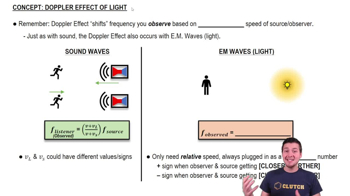
The Doppler Effect (Light)

Cosmological Redshift

Cosmological redshift refers to the phenomenon where light from distant galaxies is shifted to longer wavelengths due to the expansion of the universe. As a galaxy moves away, the light it emits stretches, resulting in a redshift that can be measured. This redshift is directly related to the velocity of the galaxy, which can then be used to infer its distance from Earth.