Ch. 38 - Quantum Mechanics

Giancoli Douglas5th editionPhysics for Scientists and EngineersISBN: 9780137488179
Not the one you use?Change textbookSelect a different textbook
Table of contents
- Ch. 01 - Introduction, Measurement, Estimating10
- Ch. 02 - Describing Motion: Kinematics in One Dimension30
- Ch. 03 - Kinematics in Two or Three Dimensions; Vectors15
- Ch. 04 - Dynamics: Newton's Laws of Motion16
- Ch. 05 - Using Newton's Laws: Friction, Circular Motion, Drag Forces22
- Ch. 06 - Gravitation and Newton's Synthesis10
- Ch. 07 - Work and Energy21
- Ch. 08 - Conservation of Energy33
- Ch. 09 - Linear Momentum26
- Ch. 10 - Rotational Motion41
- Ch. 11 - Angular Momentum; General Rotation27
- Ch. 12 - Static Equilibrium; Elasticity and Fracture27
- Ch. 13 - Fluids28
- Ch. 14 - Oscillations14
- Ch. 15 - Wave Motion35
- Ch. 16 - Sound5
- Ch. 17 - Temperature, Thermal Expansion, and the Ideal Gas Law40
- Ch. 18 - Kinetic Theory of Gases18
- Ch. 19 - Heat and the First Law of Thermodynamics31
- Ch. 20 - Second Law of Thermodynamics32
- Ch. 21 - Electric Charge and Electric Field7
- Ch. 23 - Electric Potential20
- Ch. 24 - Capacitance, Dielectrics, Electric Energy, Storage15
- Ch. 25 - Electric Current and Resistance32
- Ch. 26 - DC Circuits22
- Ch. 27 - Magnetism21
- Ch. 28 - Sources of Magnetic Field24
- Ch. 29 - Electromagnetic Induction and Faraday's Law21
- Ch. 30 - Inductance, Electromagnetic Oscillations, and AC Circuits42
- Ch. 31 - Maxwell's Equations and Electromagnetic Waves25
- Ch. 32 - Light: Reflection and Refraction42
- Ch. 33 - Lenses and Optical Instruments21
- Ch. 34 - The Wave Nature of Light: Interference and Polarization26
- Ch. 35 - Diffraction24
- Ch. 36 - The Special Theory of Relativity29
- Ch. 38 - Quantum Mechanics1
- Ch. 40 - Molecules and Solids6
- Ch. 43 - Elementary Particles3
- Ch. 44 - Astrophysics and Cosmology9
Giancoli Douglas5th editionPhysics for Scientists and EngineersISBN: 9780137488179Not the one you use?Change textbook

Chapter 36, Problem 2
Pellets of mass 2.0 g are fired in parallel paths with speeds of 150 m/s through a hole 3.0 mm in diameter. How far from the hole must you be to detect a 1.0-cm-diameter spread in the beam of pellets?
 Verified step by step guidance
1
Convert all given quantities to SI units for consistency. The mass of the pellets is 2.0 g = 0.002 kg, the speed is 150 m/s, the hole diameter is 3.0 mm = 0.003 m, and the desired spread diameter is 1.0 cm = 0.01 m.
Understand that the spread of the beam is due to the angular divergence caused by the finite size of the hole. The angular spread θ can be approximated as θ ≈ d / L, where d is the diameter of the hole and L is the distance from the hole to the point of observation.
The spread of the beam at a distance L is given by Δx = θ × L. Substituting θ ≈ d / L into this equation, we get Δx = (d / L) × L = d. To achieve a spread of 1.0 cm (0.01 m), we need to solve for L.
Rearrange the equation for L: L = Δx / θ. Since θ ≈ d / L, substitute θ = d / L into the equation to get L = Δx / (d / L). Simplify to find L = (Δx × L) / d.
Solve for L explicitly: L = Δx / d. Substitute the values Δx = 0.01 m and d = 0.003 m into the equation to calculate the distance L.
Verified video answer for a similar problem:
This video solution was recommended by our tutors as helpful for the problem above.

Video duration:
7mKey Concepts
Here are the essential concepts you must grasp in order to answer the question correctly.
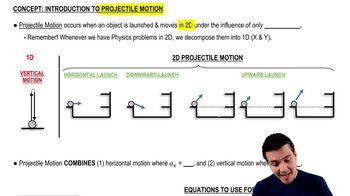
Projectile Motion
Projectile motion refers to the motion of an object that is launched into the air and is subject to gravitational forces. In this scenario, the pellets are fired horizontally, and their trajectory will be influenced by gravity, causing them to spread out as they travel. Understanding the principles of projectile motion helps in calculating the distance over which the pellets will spread.
Recommended video:
Guided course
 04:44
04:44
Introduction to Projectile Motion
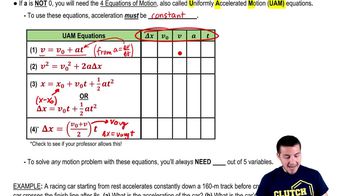
Kinematics
Kinematics is the branch of physics that deals with the motion of objects without considering the forces that cause the motion. It involves concepts such as velocity, acceleration, and displacement. In this problem, kinematic equations can be used to determine how far the pellets travel before they spread to a specified diameter, taking into account their initial speed and the time of flight.
Recommended video:
Guided course
 08:25
08:25Kinematics Equations
Beam Divergence
Beam divergence refers to the spreading of a beam of particles or waves as it travels through space. In this case, the pellets will diverge from their initial path due to their finite size and the effects of air resistance. Understanding beam divergence is crucial for calculating the distance required to achieve a specific spread in the pellet beam, as it directly relates to the initial conditions and the geometry of the setup.
Recommended video:
Guided course
 13:40
13:40Beam supporting an object
0