
Ch. 35 - Diffraction
Giancoli Douglas - Physics for Scientists and Engineers 5th edition
Giancoli Douglas5th editionPhysics for Scientists and EngineersISBN: 9780137488179Not the one you use?Change textbook
Chapter 34, Problem 4

Light of wavelength 580 nm falls on a slit that is 3.50 x 10⁻³ mm wide. Estimate how far the first brightest diffraction fringe is from the strong central maximum if the screen is 10.0 m away.

Verified step by step guidance
1
Convert the given wavelength (580 nm) and slit width (3.50 x 10⁻³ mm) into meters for consistency in SI units. Use the conversions: 1 nm = 10⁻⁹ m and 1 mm = 10⁻³ m.
Recall the formula for the angular position of the first diffraction minimum in a single-slit diffraction pattern: a sin(θ) = mλ, where 'a' is the slit width, 'λ' is the wavelength, and 'm' is the order of the minimum (m = 1 for the first minimum).
Solve for the angle θ using the equation: sin(θ) = mλ / a. Substitute the values for 'm', 'λ', and 'a' into the equation.
Once θ is determined, calculate the position of the first brightest fringe (which is near the first minimum) on the screen using the small angle approximation: y = L tan(θ), where 'L' is the distance to the screen (10.0 m). For small angles, tan(θ) ≈ sin(θ), so y ≈ L sin(θ).
Substitute the calculated value of sin(θ) and the given screen distance (L = 10.0 m) into the equation y ≈ L sin(θ) to find the distance of the first brightest fringe from the central maximum.

Verified video answer for a similar problem:

This video solution was recommended by our tutors as helpful for the problem above.
Video duration:
6m
Was this helpful?

Key Concepts

Here are the essential concepts you must grasp in order to answer the question correctly.

Diffraction

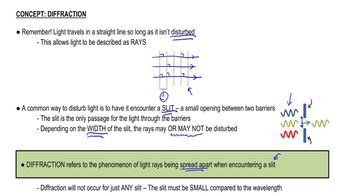
Diffraction is the bending of waves around obstacles and the spreading of waves when they pass through narrow openings. In the context of light, diffraction occurs when light waves encounter a slit, leading to the formation of a pattern of bright and dark fringes on a screen. The extent of diffraction depends on the wavelength of the light and the size of the slit.
Recommended video:

Wavelength

Wavelength is the distance between successive peaks of a wave, typically measured in nanometers (nm) for light. In this question, the wavelength of 580 nm indicates the color of light being used, which affects the diffraction pattern produced. Longer wavelengths result in more pronounced diffraction effects, leading to wider spacing between fringes.
Recommended video:
Guided course
05:42
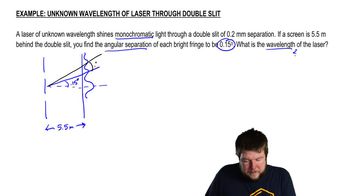
Unknown Wavelength of Laser through Double Slit

Fringe Spacing

Fringe spacing refers to the distance between consecutive bright or dark spots in a diffraction pattern. It can be calculated using the formula for single-slit diffraction, which relates the wavelength, slit width, and distance to the screen. Understanding fringe spacing is crucial for predicting where the first bright fringe will appear relative to the central maximum.
Recommended video:
Guided course
09:05
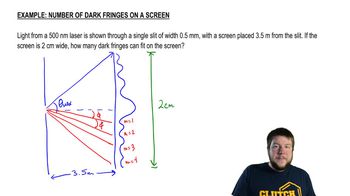
Number of Dark Fringes on a Screen