
Ch. 35 - Diffraction
Giancoli Douglas - Physics for Scientists and Engineers 5th edition
Giancoli Douglas5th editionPhysics for Scientists and EngineersISBN: 9780137488179Not the one you use?Change textbook
Chapter 34, Problem 2

Monochromatic light falls on a slit that is 2.60 x 10⁻³ mm wide. If the angle between the first dark fringes on either side of the central maximum is 29.0° (dark fringe to dark fringe), what is the wavelength of the light used?

Verified step by step guidance
1
Understand the problem: This is a single-slit diffraction problem. The angle between the first dark fringes on either side of the central maximum is given as 29.0°. This means the angle to one of the first dark fringes (from the center) is half of this value, i.e., 14.5°. The goal is to find the wavelength of the light (λ). The formula for the position of the first dark fringe in single-slit diffraction is: asinθ=mλ, where a is the slit width, θ is the angle to the dark fringe, m is the order of the dark fringe (1 for the first dark fringe), and λ is the wavelength.
Identify the known values: The slit width a is given as 2.60×10⁻³mm, which should be converted to meters: 2.60×10⁻⁶m. The angle to the first dark fringe is 14.5°. The order of the dark fringe m is 1.
Rearrange the formula to solve for the wavelength λ: λ=asinθ. Substitute the known values into the formula: λ=2.60×10⁻⁶m÷sin14.5°.
Convert the angle from degrees to radians if necessary, as trigonometric functions in physics often use radians. Use the conversion factor: θ(radians)=θ(degrees)×π180. For 14.5°, calculate sinθ.
Substitute the value of sinθ into the formula and simplify to find the wavelength λ. Ensure the final result is expressed in meters (or convert to nanometers if needed, using 1nm=10-9m).

Verified video answer for a similar problem:

This video solution was recommended by our tutors as helpful for the problem above.
Video duration:
3m
Was this helpful?

Key Concepts

Here are the essential concepts you must grasp in order to answer the question correctly.

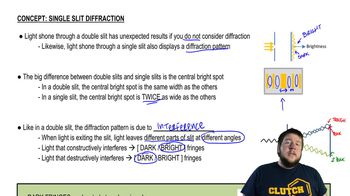
Single-Slit Diffraction

Single-slit diffraction occurs when light passes through a narrow opening, causing it to spread out and create a pattern of bright and dark fringes on a screen. The width of the slit and the wavelength of the light determine the angle and position of these fringes. The first dark fringe on either side of the central maximum is particularly important for calculating the wavelength.
Recommended video:
Guided course
12:33
Single Slit Diffraciton

Wavelength and Angle Relationship

The relationship between the wavelength of light, the slit width, and the angle of the dark fringes is described by the formula: a sin(θ) = mλ, where 'a' is the slit width, 'θ' is the angle to the dark fringe, 'm' is the order of the fringe (1 for the first dark fringe), and 'λ' is the wavelength. This relationship allows us to calculate the wavelength when the slit width and angle are known.
Recommended video:
Guided course
03:43
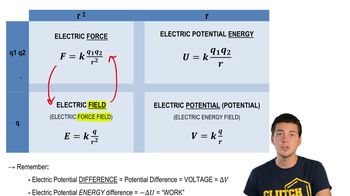
Relationships Between Force, Field, Energy, Potential

Measurement Units in Physics

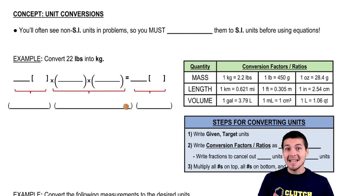
In physics, it is crucial to use consistent measurement units when performing calculations. The slit width is given in millimeters, which should be converted to meters for compatibility with the wavelength, typically measured in meters. Understanding how to convert between units ensures accurate results in calculations involving physical phenomena.
Recommended video:
Guided course
07:46
Unit Conversions