Textbook Question
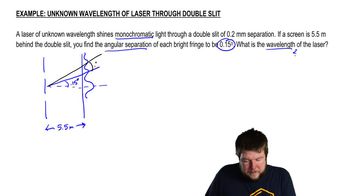
Monochromatic light falling on two slits 0.018 mm apart produces the fifth-order bright fringe at a 12° angle. What is the wavelength of the light used?
2
views

 Giancoli Douglas 5th editionCh. 34 - The Wave Nature of Light: Interference and PolarizationProblem 12
 Verified step by step guidance

 12:00
12:00
 05:42
05:42 03:47
03:47Monochromatic light falling on two slits 0.018 mm apart produces the fifth-order bright fringe at a 12° angle. What is the wavelength of the light used?
(II) Suppose a thin piece of glass is placed in front of the lower slit in Fig. 34–7 so that the two waves enter the slits 180° out of phase (Fig. 34–44). Describe in detail the interference pattern on the screen.
(II) Assume that light of a single color, rather than white light, passes through the two-slit setup described in Example 34–4. If the distance from the central fringe to a first-order fringe is measured to be 2.9 mm on the screen, determine the light’s wavelength (in nm) and color (see Fig. 34–11).
In a two-slit interference experiment, the path length to a certain point P on the screen differs for one slit in comparison with the other by 1.25λ.
(a) What is the phase difference between the two waves arriving at point P?
(b) Determine the intensity at P, expressed as a fraction of the maximum intensity Iₒ on the screen.
Suppose that one slit of a double-slit apparatus is wider than the other so that the intensity of light passing through it is twice as great. Determine the intensity I as a function of position (θ) on the screen for coherent light.