Ch. 34 - The Wave Nature of Light: Interference and Polarization
Giancoli Douglas - Physics for Scientists and Engineers 5th edition
Giancoli Douglas5th editionPhysics for Scientists and EngineersISBN: 9780137488179Not the one you use?Change textbook
Chapter 33, Problem 2

Monochromatic light falling on two slits 0.018 mm apart produces the fifth-order bright fringe at a 12° angle. What is the wavelength of the light used?

Verified step by step guidance
1
Step 1: Recall the formula for the position of bright fringes in a double-slit interference pattern: \( d \sin \theta = m \lambda \), where \( d \) is the distance between the slits, \( \theta \) is the angle of the bright fringe, \( m \) is the order of the fringe, and \( \lambda \) is the wavelength of the light.
Step 2: Identify the given values from the problem: \( d = 0.018 \; \text{mm} = 0.018 \times 10^{-3} \; \text{m} \), \( \theta = 12^{\circ} \), and \( m = 5 \) (fifth-order bright fringe).
Step 3: Rearrange the formula to solve for the wavelength \( \lambda \): \( \lambda = \frac{d \sin \theta}{m} \).
Step 4: Substitute the known values into the formula: \( \lambda = \frac{(0.018 \times 10^{-3}) \sin(12^{\circ})}{5} \).
Step 5: Use a calculator to compute \( \sin(12^{\circ}) \), multiply by \( d \), and divide by \( m \) to find the wavelength \( \lambda \). Ensure the final result is expressed in meters or converted to nanometers (1 nm = \( 10^{-9} \; \text{m} \)).

Verified video answer for a similar problem:

This video solution was recommended by our tutors as helpful for the problem above.
Video duration:
6m
Was this helpful?

Key Concepts

Here are the essential concepts you must grasp in order to answer the question correctly.

Double-Slit Experiment

The double-slit experiment demonstrates the wave nature of light through interference patterns created when light passes through two closely spaced slits. When monochromatic light is used, it produces alternating bright and dark fringes on a screen due to constructive and destructive interference, respectively. The position of these fringes depends on the wavelength of the light and the distance between the slits.
Recommended video:
Guided course
12:00
Young's Double Slit Experiment

Interference Pattern

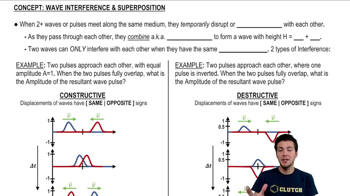
An interference pattern is formed when two or more overlapping waves combine, resulting in regions of increased (constructive interference) and decreased (destructive interference) intensity. In the context of the double-slit experiment, the bright fringes correspond to points where the path difference between the waves from the two slits is an integer multiple of the wavelength, while dark fringes occur at half-integer multiples.
Recommended video:
Guided course
03:47
Wave Interference & Superposition

Wavelength Calculation

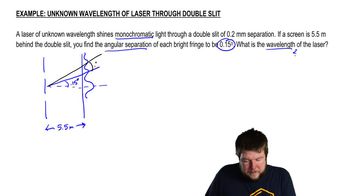
The wavelength of light can be calculated using the formula for the position of bright fringes in a double-slit setup: d sin(θ) = mλ, where d is the distance between the slits, θ is the angle of the fringe, m is the order of the fringe, and λ is the wavelength. By rearranging this equation, one can solve for the wavelength when the other variables are known, such as the slit separation and the angle of the observed fringe.
Recommended video:
Guided course
05:42
Unknown Wavelength of Laser through Double Slit