
Ch. 32 - Light: Reflection and Refraction
Giancoli Douglas - Physics for Scientists and Engineers 5th edition
Giancoli Douglas5th editionPhysics for Scientists and EngineersISBN: 9780137488179Not the one you use?Change textbook
Chapter 31, Problem 44

(II) In searching the bottom of a pool at night, a watchman shines a narrow beam of light from his flashlight, 1.3 m above the water level, onto the surface of the water at a point 2.8 m from his foot at the edge of the pool (Fig. 32–53). Where does the spot of light hit the bottom of the pool which is 2.1 m deep? Measure from the bottom of the wall beneath his foot.


<IMAGE>

Verified step by step guidance
1
Determine the angle of incidence of the light beam at the water's surface. Use trigonometry to calculate this angle. The flashlight is 1.3 m above the water level, and the horizontal distance to the point where the beam hits the water is 2.8 m. The angle of incidence θ₁ can be found using the tangent function: tan(θ₁) = opposite/adjacent = 1.3/2.8. Solve for θ₁.
Apply Snell's Law to find the angle of refraction θ₂ as the light enters the water. Snell's Law is given by: n₁ * sin(θ₁) = n₂ * sin(θ₂), where n₁ is the refractive index of air (approximately 1), and n₂ is the refractive index of water (approximately 1.33). Solve for sin(θ₂) and then find θ₂.
Determine the horizontal distance traveled by the light beam underwater. Use trigonometry again, considering the depth of the pool (2.1 m) and the angle of refraction θ₂. The horizontal distance d₂ can be calculated using: d₂ = depth / tan(θ₂).
Add the horizontal distance traveled by the light beam underwater (d₂) to the horizontal distance from the watchman’s foot to the point where the beam hits the water (2.8 m). This total distance gives the location of the spot of light on the bottom of the pool, measured from the wall beneath the watchman’s foot.
Summarize the process: First, calculate the angle of incidence using trigonometry. Then, use Snell's Law to find the angle of refraction. Finally, use trigonometry again to determine the horizontal distance traveled underwater and add it to the initial horizontal distance to find the total distance to the spot of light on the pool's bottom.

Verified video answer for a similar problem:

This video solution was recommended by our tutors as helpful for the problem above.
Video duration:
9m
Was this helpful?

Key Concepts

Here are the essential concepts you must grasp in order to answer the question correctly.

Refraction of Light

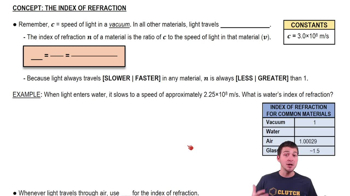
Refraction is the bending of light as it passes from one medium to another, such as from air into water. This phenomenon occurs due to the change in the speed of light in different materials. The angle at which light enters the water affects how it bends, which is described by Snell's Law. Understanding refraction is crucial for determining where the light beam will hit the bottom of the pool.
Recommended video:
Guided course
03:46
Index of Refraction

Geometry of Light Paths

The geometry of light paths involves analyzing the angles and distances involved when light travels from one point to another. In this scenario, the watchman's flashlight creates a right triangle where the height of the light source and the distance from the foot to the point on the water's surface are key dimensions. By applying trigonometric principles, one can calculate the position where the light beam strikes the bottom of the pool.
Recommended video:
Guided course
08:20
Mean Free Path

Depth of the Pool

The depth of the pool is a critical factor in determining where the light spot will land on the bottom. In this case, the pool is 2.1 m deep, which means that the light beam must be analyzed not only in terms of its entry point but also how far it travels vertically downwards. This depth influences the final position of the light spot, requiring a combination of refraction and geometric calculations to find the exact location.
Recommended video:
Guided course
17:04
Pressure and Atmospheric Pressure
Related Practice
Textbook Question

(III) A light ray is incident on a flat piece of glass with index of refraction n as in Fig. 32–24. Show that if the incident angle θ is small, the emerging ray is displaced a distance d = tθ(n - 1)/n , where t is the thickness of the glass, θ is in radians, and d is the perpendicular distance between the incident ray and the (dashed) line of the emerging ray (Fig. 32–24).

1
views
Textbook Question

A parallel beam of light containing two wavelengths, λ₁ = 461 nm and λ₂ = 656 nm, enters the silicate flint glass of an equilateral prism as shown in Fig. 32–56. At what angle does each beam leave the prism (give angle with normal to the face)? See Fig. 32–28.

1
views
Textbook Question

A light beam strikes a 2.5-cm-thick piece of plastic with a refractive index of 1.62 at a 45° angle. The plastic is on top of a 3.8-cm-thick piece of glass for which n = 1.47. What is the distance D in Fig. 32–51?

2
views
Textbook Question

An object is placed a distance r in front of a wall, where r exactly equals the radius of curvature of a certain concave mirror. At what distance from the wall should this mirror be placed so that a real image of the object is formed on the wall? What is the lateral magnification of the image?

2
views
Textbook Question

A light beam strikes a piece of glass at a 55.00° incident angle. The beam contains two wavelengths, 450.0 nm and 700.0 nm, for which the index of refraction of the glass is 1.4831 and 1.4754, respectively. What is the angle between the two refracted beams?

2
views
Textbook Question

A flashlight beam strikes the surface of a pane of glass (n = 1.56) at a 69° angle to the normal. What is the angle of refraction?

1
views