
(III) A light ray is incident on a flat piece of glass with index of refraction n as in Fig. 32–24. Show that if the incident angle θ is small, the emerging ray is displaced a distance d = tθ(n - 1)/n , where t is the thickness of the glass, θ is in radians, and d is the perpendicular distance between the incident ray and the (dashed) line of the emerging ray (Fig. 32–24).
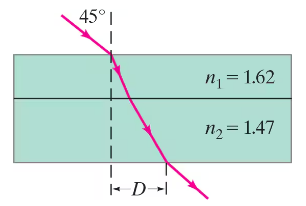
A light beam strikes a 2.5-cm-thick piece of plastic with a refractive index of 1.62 at a 45° angle. The plastic is on top of a 3.8-cm-thick piece of glass for which n = 1.47. What is the distance D in Fig. 32–51?

Verified step by step guidance
Verified video answer for a similar problem:
Key Concepts
Refraction
Refractive Index
Geometry of Light Paths
(II) In searching the bottom of a pool at night, a watchman shines a narrow beam of light from his flashlight, 1.3 m above the water level, onto the surface of the water at a point 2.8 m from his foot at the edge of the pool (Fig. 32–53). Where does the spot of light hit the bottom of the pool which is 2.1 m deep? Measure from the bottom of the wall beneath his foot.
<IMAGE>
An object is placed a distance r in front of a wall, where r exactly equals the radius of curvature of a certain concave mirror. At what distance from the wall should this mirror be placed so that a real image of the object is formed on the wall? What is the lateral magnification of the image?
A light beam strikes a piece of glass at a 55.00° incident angle. The beam contains two wavelengths, 450.0 nm and 700.0 nm, for which the index of refraction of the glass is 1.4831 and 1.4754, respectively. What is the angle between the two refracted beams?
A shaving or makeup mirror is designed to magnify your face by a factor of 1.8 (when compared to a flat mirror) when your face is placed 20.0 cm in front of it.
(a) What type of mirror is it?
(b) Describe the type of image that it makes of your face.
(c) Calculate the required radius of curvature for the mirror.
A flashlight beam strikes the surface of a pane of glass (n = 1.56) at a 69° angle to the normal. What is the angle of refraction?
