Ch. 28 - Sources of Magnetic Field
Giancoli Douglas - Physics for Scientists and Engineers 5th edition
Giancoli Douglas5th editionPhysics for Scientists and EngineersISBN: 9780137488179Not the one you use?Change textbook
Chapter 27, Problem 13

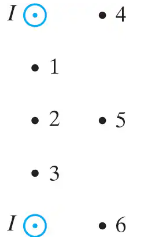
(II) Two long straight wires each carry a dc current I out of the page toward the viewer, Fig. 28–38. Indicate, with appropriate arrows, the direction of B\(\overrightarrow{B}\) at each of the points 1 to 6 in the plane of the page. State if the field is zero at any of the points.

Verified step by step guidance
1
Understand the problem: The magnetic field (B) around a current-carrying wire is determined by the right-hand rule. For a current coming out of the page, curl the fingers of your right hand around the wire in the direction of the magnetic field. The thumb points in the direction of the current.
Apply the right-hand rule to each wire: For each wire, determine the direction of the magnetic field at the given points (1 to 6). The magnetic field forms concentric circles around the wire, with the direction depending on the current's orientation.
Superposition principle: At each point, the net magnetic field is the vector sum of the magnetic fields produced by both wires. If the fields from the two wires cancel each other out, the net field at that point is zero.
Analyze each point: For each of the points (1 to 6), determine the direction of the magnetic field from each wire and calculate the resultant field. For example, if the fields are in opposite directions, subtract their magnitudes; if they are in the same direction, add them.
Identify zero-field points: If the magnetic fields from the two wires are equal in magnitude but opposite in direction at a specific point, the net field at that point is zero. Check each point to determine if this condition is met.

Verified video answer for a similar problem:

This video solution was recommended by our tutors as helpful for the problem above.
Video duration:
6m
Was this helpful?

Key Concepts

Here are the essential concepts you must grasp in order to answer the question correctly.

Magnetic Field Due to a Current-Carrying Wire

A long straight wire carrying a direct current generates a magnetic field around it. The direction of this magnetic field can be determined using the right-hand rule: if you point your thumb in the direction of the current, your fingers curl in the direction of the magnetic field lines. This concept is fundamental for analyzing the magnetic field produced by the two wires in the question.
Recommended video:
Guided course
09:57
Magnetic Force on Current-Carrying Wire

Superposition Principle of Magnetic Fields

The superposition principle states that the total magnetic field at a point due to multiple sources is the vector sum of the individual fields produced by each source. In this case, the magnetic fields from both wires must be calculated and combined to determine the resultant field at points 1 to 6. This principle is crucial for understanding how the fields interact and whether they cancel each other out.
Recommended video:
Guided course
03:32
Superposition of Sinusoidal Wave Functions

Direction of Magnetic Field Lines

Magnetic field lines indicate the direction and strength of the magnetic field. The direction of the field lines is defined as the direction a north magnetic pole would move. In the context of the question, identifying the direction of the magnetic field at various points requires understanding how the fields from the two wires interact, which can lead to points where the field is zero or has a specific direction.
Recommended video:
Guided course
08:20
Electric Field Lines