Ch. 28 - Sources of Magnetic Field
Giancoli Douglas - Physics for Scientists and Engineers 5th edition
Giancoli Douglas5th editionPhysics for Scientists and EngineersISBN: 9780137488179Not the one you use?Change textbook
Chapter 27, Problem 5

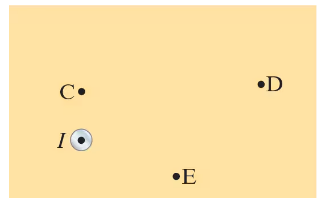
(II) In Fig. 28–36, a long straight wire carries current I out of the page toward you. Indicate, with appropriate arrows, the direction and (relative) magnitude of B\(\overrightarrow{B}\) at each of the points C, D, and E in the plane of the page.

Verified step by step guidance
1
Step 1: Understand the problem. The problem involves determining the direction and relative magnitude of the magnetic field (B) at points C, D, and E due to a long straight wire carrying current I out of the page. The wire generates a magnetic field around it, and the direction of the field can be determined using the right-hand rule.
Step 2: Apply the right-hand rule. For a current coming out of the page, curl the fingers of your right hand around the wire in the direction of the magnetic field. Your thumb points in the direction of the current (out of the page), and your fingers indicate the circular direction of the magnetic field lines around the wire.
Step 3: Determine the direction of B at each point. At point C, which is to the left of the wire, the magnetic field will point downward. At point D, which is directly above the wire, the magnetic field will point to the left. At point E, which is to the right of the wire, the magnetic field will point upward.
Step 4: Consider the relative magnitude of B. The magnitude of the magnetic field decreases with distance from the wire. Use the formula for the magnetic field around a long straight wire: B=μ0I2πr, where μ₀ is the permeability of free space, I is the current, and r is the distance from the wire. Points closer to the wire will have a stronger magnetic field.
Step 5: Summarize the findings. At point C, the magnetic field points downward and is relatively strong if close to the wire. At point D, the magnetic field points to the left and is strongest because it is closest to the wire. At point E, the magnetic field points upward and is weaker if farther from the wire. Use arrows to indicate these directions and relative magnitudes on the diagram.

Verified video answer for a similar problem:

This video solution was recommended by our tutors as helpful for the problem above.
Video duration:
4m
Was this helpful?

Key Concepts

Here are the essential concepts you must grasp in order to answer the question correctly.

Magnetic Field Around a Current-Carrying Wire

A long straight wire carrying an electric current generates a magnetic field around it. The direction of this magnetic field can be determined using the right-hand rule: if you point your thumb in the direction of the current, your fingers curl in the direction of the magnetic field lines. The strength of the magnetic field decreases with distance from the wire.
Recommended video:
Guided course
09:57
Magnetic Force on Current-Carrying Wire

Right-Hand Rule

The right-hand rule is a mnemonic used to determine the direction of the magnetic field produced by a current-carrying conductor. By aligning your right thumb with the direction of the current and curling your fingers, the direction your fingers point indicates the direction of the magnetic field lines. This rule is essential for visualizing magnetic field orientations in relation to current flow.
Recommended video:
Guided course
19:11
Force on Moving Charges & Right Hand Rule

Magnitude of Magnetic Field

The magnitude of the magnetic field (B) created by a long straight wire is given by the formula B = (μ₀I)/(2πr), where μ₀ is the permeability of free space, I is the current, and r is the distance from the wire. This relationship shows that the magnetic field strength is directly proportional to the current and inversely proportional to the distance from the wire, which is crucial for determining the field at points C, D, and E.
Recommended video:
Guided course
05:30
Magnetic Fields and Magnetic Dipoles