
Ch. 27 - Magnetism
Giancoli Douglas - Physics for Scientists and Engineers 5th edition
Giancoli Douglas5th editionPhysics for Scientists and EngineersISBN: 9780137488179Not the one you use?Change textbook
Chapter 26, Problem 66

Near the equator, the Earth’s magnetic field points almost horizontally to the north and has magnitude B = 0.50 x 10⁻⁴ T. What should be the magnitude and direction for the velocity of an electron if its weight is to be exactly balanced by the magnetic force?

Verified step by step guidance
1
Understand the forces acting on the electron: The weight of the electron is given by its gravitational force, which is \( F_g = m_e g \), where \( m_e \) is the mass of the electron and \( g \) is the acceleration due to gravity. The magnetic force acting on the electron is \( F_B = q v B \sin \theta \), where \( q \) is the charge of the electron, \( v \) is its velocity, \( B \) is the magnetic field strength, and \( \theta \) is the angle between the velocity and the magnetic field.
Set up the condition for balance: For the electron's weight to be balanced by the magnetic force, \( F_B = F_g \). Substituting the expressions for \( F_B \) and \( F_g \), we get \( q v B \sin \theta = m_e g \).
Simplify the equation: Since the magnetic field is horizontal and we want the magnetic force to counteract the vertical gravitational force, the velocity of the electron must be perpendicular to the magnetic field (\( \theta = 90^\circ \)), so \( \sin \theta = 1 \). The equation simplifies to \( v = \frac{m_e g}{q B} \).
Substitute known values: Use the following constants: \( m_e = 9.11 \times 10^{-31} \, \text{kg} \), \( g = 9.8 \; \text{m/s}^2 \), \( q = 1.6 \times 10^{-19} \, \text{C} \), and \( B = 0.50 \times 10^{-4} \, \text{T} \). Substitute these into the equation to find \( v \).
Determine the direction of the velocity: Use the right-hand rule for the magnetic force. Since the magnetic field points north and the force must point upward to balance gravity, the velocity of the electron must point eastward. Thus, the velocity has a magnitude calculated in the previous step and a direction to the east.

Verified video answer for a similar problem:

This video solution was recommended by our tutors as helpful for the problem above.
Video duration:
7m
Was this helpful?

Key Concepts

Here are the essential concepts you must grasp in order to answer the question correctly.

Magnetic Force

The magnetic force on a charged particle moving in a magnetic field is given by the Lorentz force equation, F = q(v × B), where F is the magnetic force, q is the charge of the particle, v is its velocity, and B is the magnetic field. This force acts perpendicular to both the velocity of the particle and the direction of the magnetic field, which is crucial for understanding how charged particles behave in magnetic fields.
Recommended video:
Guided course
09:57
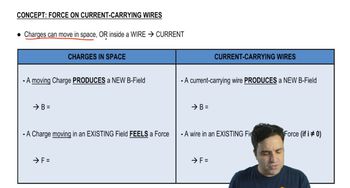
Magnetic Force on Current-Carrying Wire

Weight of an Electron

The weight of an electron is the force due to gravity acting on it, calculated using the equation W = mg, where m is the mass of the electron (approximately 9.11 x 10⁻³¹ kg) and g is the acceleration due to gravity (approximately 9.81 m/s²). This force acts downward and must be balanced by the upward magnetic force for the electron to remain in equilibrium.
Recommended video:
Guided course
10:19
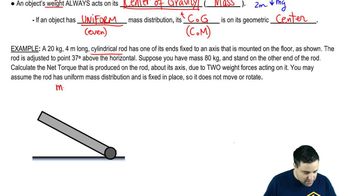
Torque Due to Weight

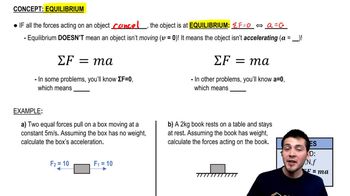
Equilibrium of Forces

For an object to be in equilibrium, the net force acting on it must be zero. In this scenario, the weight of the electron must be balanced by the magnetic force. This condition allows us to set up an equation relating the velocity of the electron to the magnetic field strength and the charge of the electron, enabling us to solve for the required velocity.
Recommended video:
Related Practice
Textbook Question

Suppose the Earth’s magnetic field at the equator has magnitude 0.50 x 10⁻⁴ T and a northerly direction at all points. Estimate the speed a singly ionized uranium ion ( m = 238 u, q = e) would need to circle the Earth 5.0 km above the equator. Can you ignore gravity? [Ignore relativity.]

2
views
Textbook Question

Suppose the electric field between the electric plates in the mass spectrometer of Fig. 27–34 is 2.84 x 10⁴ V/m and the magnetic fields are B = B'= 0.58 T. The source contains carbon isotopes of mass numbers 12, 13, and 14 from a long-dead piece of a tree. (To estimate atomic masses, multiply by 1.67 x 10⁻²⁷ kg.) Does it matter if the ion charge is positive (lost electrons) or negative (gained electrons)? Explain.

2
views
Textbook Question

Suppose the electric field between the electric plates in the mass spectrometer of Fig. 27–34 is 2.84 x 10⁴ V/m and the magnetic fields are B = B'= 0.58 T. The source contains carbon isotopes of mass numbers 12, 13, and 14 from a long-dead piece of a tree. (To estimate atomic masses, multiply by 1.67 x 10⁻²⁷ kg .) How far apart are the marks formed by the singly charged ions of each type on a detector or photographic film? What if the ions were doubly charged?

1
views
Textbook Question

A uniform conducting rod of length ℓ and mass m sits atop a fulcrum, which is placed a distance ℓ/4 from the rod’s left-hand end and is immersed in a uniform magnetic field of magnitude B directed into the page (Fig. 27–54). An object whose mass M is 7.0 times greater than the rod’s mass is hung from the rod’s left-hand end. What current (direction and magnitude) should flow through the rod in order for it to be “balanced” (i.e., be at rest horizontally) on the fulcrum? (Flexible connecting wires which exert negligible force on the rod are not shown.)


2
views
Textbook Question

The magnetic field B at the center of a circular coil of wire carrying a current I (as in Fig. 27–9) is B = (μ₀NI) / 2r where N is the number of loops in the coil and r is its radius. Imagine a simple model in which the Earth’s magnetic field of about 1 G ( = 1 x 10⁻⁴ T) near the poles is produced by a single current loop around the equator. Roughly estimate the current this loop would carry.

1
views
Textbook Question

A mass spectrometer is monitoring air pollutants. It is difficult, however, to separate molecules of nearly equal mass such as CO (28.0106 u) and N₂ (28.0134 u). How large a radius of curvature must a spectrometer have (Fig. 27–34) if these two molecules are to be separated on the detector by 0.50 mm?

1
views