

Near the equator, the Earth’s magnetic field points almost horizontally to the north and has magnitude B = 0.50 x 10⁻⁴ T. What should be the magnitude and direction for the velocity of an electron if its weight is to be exactly balanced by the magnetic force?
Suppose the electric field between the electric plates in the mass spectrometer of Fig. 27–34 is 2.84 x 10⁴ V/m and the magnetic fields are B = B'= 0.58 T. The source contains carbon isotopes of mass numbers 12, 13, and 14 from a long-dead piece of a tree. (To estimate atomic masses, multiply by 1.67 x 10⁻²⁷ kg .) How far apart are the marks formed by the singly charged ions of each type on a detector or photographic film? What if the ions were doubly charged?
Verified step by step guidance
Verified video answer for a similar problem:
Key Concepts
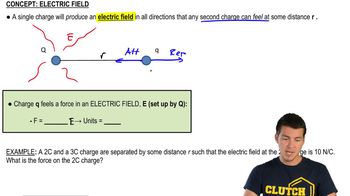
Electric Field
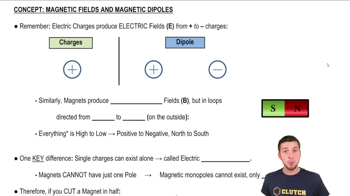
Magnetic Field
Mass Spectrometry
Suppose the electric field between the electric plates in the mass spectrometer of Fig. 27–34 is 2.84 x 10⁴ V/m and the magnetic fields are B = B'= 0.58 T. The source contains carbon isotopes of mass numbers 12, 13, and 14 from a long-dead piece of a tree. (To estimate atomic masses, multiply by 1.67 x 10⁻²⁷ kg.) Does it matter if the ion charge is positive (lost electrons) or negative (gained electrons)? Explain.
One form of mass spectrometer accelerates ions by a voltage V before they enter a magnetic field B. The ions are assumed to start from rest. Show that the mass of an ion is m = qB²R²/2V, where R is the radius of the ions’ path in the magnetic field and q is their charge.
A long copper strip is 3.0 cm wide and thick. When it carries a steady 42-A current in a 0.80-T magnetic field it produces a 6.5-μV Hall emf. Determine:
(a) the Hall field in the conductor;
(b) the drift speed of the conduction electrons;
(c) the density of free electrons in the metal.
In a mass spectrometer, germanium atoms have radii of curvature equal to 21.0, 21.6, 21.9, 22.2, and 22.8 cm. The largest radius corresponds to an atomic mass of 76 u. What are the atomic masses of the other isotopes?
A mass spectrometer is monitoring air pollutants. It is difficult, however, to separate molecules of nearly equal mass such as CO (28.0106 u) and N₂ (28.0134 u). How large a radius of curvature must a spectrometer have (Fig. 27–34) if these two molecules are to be separated on the detector by 0.50 mm?
