Ch. 26 - DC Circuits
Giancoli Douglas - Physics for Scientists and Engineers 5th edition
Giancoli Douglas5th editionPhysics for Scientists and EngineersISBN: 9780137488179Not the one you use?Change textbook
Chapter 25, Problem 41

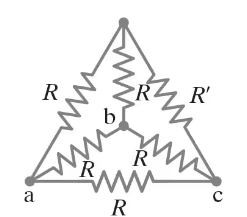
(III) Determine the net resistance in Fig. 26–61 (a) between points a and c, and (b) between points a and b. Assume R' ≠ R. [Hint: Apply an emf between the two points in each case and determine currents; use symmetry at junctions.]

Verified step by step guidance
1
Step 1: Analyze the circuit configuration. The circuit forms a triangular network with resistors R and R' connected between points a, b, and c. To find the net resistance, we need to consider the symmetry and apply the principles of series and parallel combinations.
Step 2: For part (a), determine the net resistance between points a and c. Apply an emf between these points and analyze the current distribution. Use the symmetry of the circuit to simplify the analysis. Note that the resistors connected between b and c, and b and a, are symmetric.
Step 3: For part (a), combine the resistors in series and parallel as appropriate. For example, the resistors R and R' between b and c can be treated as parallel resistors. Use the formula for parallel resistance: 1R = 1R + 1R'.
Step 4: For part (b), determine the net resistance between points a and b. Apply an emf between these points and analyze the current distribution. Again, use symmetry to simplify the circuit. Combine the resistors in series and parallel as appropriate, considering the resistors between b and c and b and a.
Step 5: After simplifying the circuit for both cases, calculate the equivalent resistance using the formulas for series and parallel combinations. For series resistors, use: Req = R1 + R2. For parallel resistors, use: 1R = 1R + 1R'.

Key Concepts

Here are the essential concepts you must grasp in order to answer the question correctly.

Ohm's Law

Ohm's Law states that the current (I) flowing through a conductor between two points is directly proportional to the voltage (V) across the two points and inversely proportional to the resistance (R) of the conductor. This relationship is expressed mathematically as V = IR. Understanding this law is crucial for analyzing circuits, as it allows for the calculation of current and voltage in relation to resistance.
Recommended video:
Guided course
03:07
Resistance and Ohm's Law

Series and Parallel Resistors

In electrical circuits, resistors can be arranged in series or parallel configurations. In a series circuit, the total resistance is the sum of individual resistances, while in a parallel circuit, the total resistance can be found using the formula 1/R_total = 1/R1 + 1/R2 + ... + 1/Rn. Recognizing these configurations is essential for determining the net resistance between points in a circuit.
Recommended video:
Guided course
12:42
Combining Resistors in Series & Parallel

Symmetry in Circuits

Symmetry in circuits refers to the property where certain elements are arranged in a way that allows for simplifications in analysis. When a circuit exhibits symmetry, such as identical resistors in a network, it can often be analyzed by considering only a portion of the circuit. This concept is particularly useful in complex circuits, as it can reduce the number of calculations needed to find equivalent resistances or currents.
Recommended video:
Guided course
12:39
Solving Symmetric Launch Problems