
Ch. 26 - DC Circuits
Giancoli Douglas - Physics for Scientists and Engineers 5th edition
Giancoli Douglas5th editionPhysics for Scientists and EngineersISBN: 9780137488179Not the one you use?Change textbook
Chapter 25, Problem 36

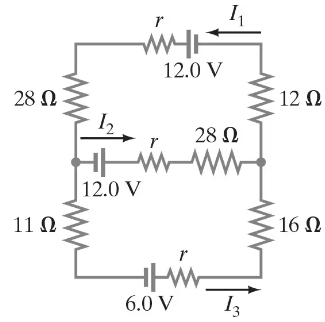
(III) (a) Determine the currents I1I2, and I3 in Fig. 26–58. Assume the internal resistance of each battery is r = 1.0 Ω.


(b) What is the terminal voltage of the 6.0-V battery?

Verified step by step guidance
1
Identify the circuit configuration in Fig. 26–58. The circuit likely involves multiple loops and resistors, with batteries providing electromotive force (emf). Label the currents I₁, I₂, and I₃ in the circuit, ensuring their directions are consistent with the problem statement.
Apply Kirchhoff's Voltage Law (KVL) to each loop in the circuit. For each loop, sum the voltage drops across resistors (using Ohm's Law, V = IR) and the emfs of the batteries. Write equations for each loop, ensuring you account for the internal resistance of the batteries (r = 1.0 Ω).
Apply Kirchhoff's Current Law (KCL) at any junction in the circuit. This law states that the total current entering a junction equals the total current leaving the junction. Use this to relate I₁, I₂, and I₃.
Solve the system of equations obtained from KVL and KCL simultaneously. This will involve substituting values for resistances, emfs, and internal resistances, and solving for the unknown currents I₁, I₂, and I₃.
To find the terminal voltage of the 6.0-V battery, use the formula V_terminal = emf - I * r, where I is the current through the battery and r is its internal resistance. Substitute the appropriate values to calculate the terminal voltage.

Verified video answer for a similar problem:

This video solution was recommended by our tutors as helpful for the problem above.
Video duration:
6m
Was this helpful?

Key Concepts

Here are the essential concepts you must grasp in order to answer the question correctly.

Ohm's Law

Ohm's Law states that the current (I) flowing through a conductor between two points is directly proportional to the voltage (V) across the two points and inversely proportional to the resistance (R) of the conductor. This relationship is expressed mathematically as V = IR. Understanding this law is essential for analyzing circuits, as it allows for the calculation of current, voltage, or resistance when the other two quantities are known.

Kirchhoff's Laws

Kirchhoff's Laws consist of two principles that deal with the conservation of charge and energy in electrical circuits. Kirchhoff's Current Law (KCL) states that the total current entering a junction must equal the total current leaving the junction. Kirchhoff's Voltage Law (KVL) states that the sum of the electrical potential differences (voltage) around any closed circuit loop must equal zero. These laws are fundamental for analyzing complex circuits and determining unknown currents and voltages.

Terminal Voltage

The terminal voltage of a battery is the voltage output available at its terminals when it is connected to a circuit. It is affected by the internal resistance of the battery and the current flowing through it. The terminal voltage can be calculated using the formula V_terminal = V_battery - I * r, where V_battery is the nominal voltage, I is the current, and r is the internal resistance. Understanding terminal voltage is crucial for determining how much voltage is actually available for circuit components.