
Ch. 21 - Electric Charge and Electric Field
Giancoli Douglas - Physics for Scientists and Engineers 5th edition
Giancoli Douglas5th editionPhysics for Scientists and EngineersISBN: 9780137488179Not the one you use?Change textbook
Chapter 21, Problem 40

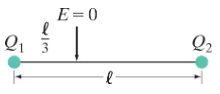
You are given two unknown point charges, Q₁ and Q₂. At a point on the line joining them, one-third of the way from Q₁ to Q₂, the electric field is zero (Fig. 21–64). What is the ratio Q₁/Q₂?
Diagram showing two point charges, Q₁ and Q₂, with electric field E=0 at a point one-third of the distance from Q₁.

Verified step by step guidance
1
Identify the key concept: The electric field at a point due to a point charge is given by the formula: E = kQr2, where k is Coulomb's constant, Q is the charge, and r is the distance from the charge to the point of interest. The electric field is zero at the given point, meaning the fields due to Q1 and Q2 must cancel each other out.
Define the distances: Let the total distance between Q1 and Q2 be d. The point where the electric field is zero is located one-third of the way from Q1 to Q2. Therefore, the distance from Q1 to the point is d3, and the distance from Q2 to the point is 23d.
Set up the condition for the electric field to be zero: The magnitudes of the electric fields due to Q1 and Q2 must be equal at the point. Using the formula for electric field, this gives: kQ1d32 = kQ2232.
Simplify the equation: Cancel out k on both sides and rearrange the terms to isolate the ratio Q1Q2. This gives: Q1Q2 = 232132.
Evaluate the ratio: Simplify the expression for the ratio Q1Q2 by calculating the squares of the fractions. This will yield the final ratio of Q1Q2.

Verified video answer for a similar problem:

This video solution was recommended by our tutors as helpful for the problem above.
Video duration:
3m
Was this helpful?

Key Concepts

Here are the essential concepts you must grasp in order to answer the question correctly.

Electric Field

The electric field is a vector field that represents the force exerted by an electric charge on other charges in its vicinity. It is defined as the force per unit charge and is directed away from positive charges and toward negative charges. The strength of the electric field decreases with distance from the charge, following an inverse square law.
Recommended video:
Guided course
03:16
Intro to Electric Fields

Superposition Principle

The superposition principle states that the total electric field created by multiple charges is the vector sum of the electric fields produced by each charge independently. This principle allows us to analyze complex charge configurations by considering the contributions of individual charges to the overall electric field at a given point.
Recommended video:
Guided course
03:32
Superposition of Sinusoidal Wave Functions

Charge Ratio

The charge ratio, in this context, refers to the relationship between the magnitudes of two point charges, Q₁ and Q₂. To find the ratio Q₁/Q₂, one must consider the conditions under which the electric field is zero at a specific point, which involves balancing the electric fields due to both charges. This ratio is crucial for determining how the magnitudes of the charges influence the electric field at that point.
Recommended video:
Guided course
04:12
Find Mass-to-Charge Ratio in Spectrometer
Related Practice