
Ch. 21 - Electric Charge and Electric Field
Giancoli Douglas - Physics for Scientists and Engineers 5th edition
Giancoli Douglas5th editionPhysics for Scientists and EngineersISBN: 9780137488179Not the one you use?Change textbook
Chapter 21, Problem 55

An electron moving to the right at 7.5 x 10⁵ m/s enters a uniform electric field parallel to its direction of motion. If the electron is to be brought to rest in the space of 5.0 cm,
(a) what direction is required for the electric field, and
(b) what is the strength of the field?

Verified step by step guidance
1
Determine the direction of the electric field: Since the electron is negatively charged, the electric field must point in the opposite direction of its motion to exert a force that decelerates it. This is because the force on a charged particle in an electric field is given by \( \mathbf{F} = q \mathbf{E} \), where \( q \) is the charge of the particle and \( \mathbf{E} \) is the electric field vector.
Use kinematic equations to find the required deceleration: The electron starts with an initial velocity \( v_0 = 7.5 \times 10^5 \ \text{m/s} \), comes to rest (\( v = 0 \)), and travels a distance \( d = 5.0 \ \text{cm} = 0.050 \ \text{m} \). Use the kinematic equation \( v^2 = v_0^2 + 2a d \) to solve for the acceleration \( a \). Rearrange to get \( a = -\frac{v_0^2}{2d} \).
Relate the acceleration to the electric field: The force on the electron is \( F = ma \), where \( m \) is the mass of the electron. The force is also given by \( F = qE \), where \( q \) is the charge of the electron. Equating these, \( ma = qE \), solve for \( E \) to get \( E = \frac{ma}{q} \).
Substitute known values into the equations: Use the mass of the electron \( m = 9.11 \times 10^{-31} \ \text{kg} \), the charge of the electron \( q = 1.60 \times 10^{-19} \ \text{C} \), and the acceleration \( a \) calculated in step 2 to find the magnitude of the electric field \( E \).
Combine the results: The direction of the electric field is opposite to the electron's motion, and the magnitude of the electric field is determined from the calculations in step 4. Ensure all units are consistent and verify the results.

Verified video answer for a similar problem:

This video solution was recommended by our tutors as helpful for the problem above.
Video duration:
7m
Was this helpful?

Key Concepts

Here are the essential concepts you must grasp in order to answer the question correctly.

Electric Field Direction

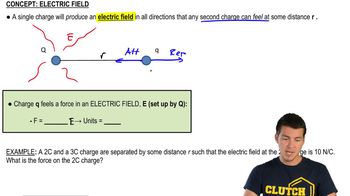
The direction of an electric field is defined as the direction a positive test charge would move. In this scenario, since the electron is moving to the right and needs to be brought to rest, the electric field must be directed to the left. This opposing direction is necessary to exert a force on the negatively charged electron, decelerating it until it stops.
Recommended video:
Guided course
03:16
Intro to Electric Fields

Force on a Charged Particle

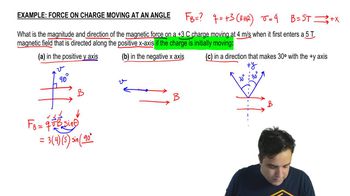
The force experienced by a charged particle in an electric field is given by F = qE, where F is the force, q is the charge of the particle, and E is the electric field strength. For an electron, which has a negative charge, the force will act in the opposite direction to the electric field. This relationship is crucial for determining how the electric field will affect the electron's motion.
Recommended video:
Guided course
06:21
Force on Charge Moving at an Angle

Kinematics and Deceleration

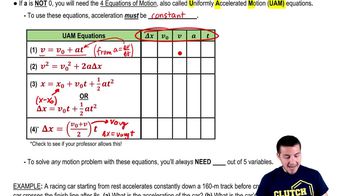
Kinematics involves the equations of motion that describe how an object moves under various forces. In this case, we can use the kinematic equation that relates initial velocity, final velocity, acceleration, and distance to find the required electric field strength. The electron's initial velocity, the distance it must travel to stop, and the need for deceleration are key factors in calculating the necessary electric field strength.
Recommended video:
Guided course
08:25
Kinematics Equations
Related Practice
Textbook Question

Draw, approximately, the electric field lines emanating from a uniformly charged straight wire whose length ℓ is not great. The spacing between lines near the wire should be much less than ℓ. [Hint: Also consider points very far from the wire up to 4ℓ \.]

2
views
Textbook Question

You are given two unknown point charges, Q₁ and Q₂. At a point on the line joining them, one-third of the way from Q₁ to Q₂, the electric field is zero (Fig. 21–64). What is the ratio Q₁/Q₂?

Textbook Question

Estimate the net force between the CO group and the HN group shown in Fig. 21–72. The C and O have charges ± 0.40e, and the H and N have charges ±0.20e, where e = 1.6 x 10⁻¹⁹ C. [Hint: Do not include the “internal” forces between C and O, or between H and N.]

1
views
Textbook Question

Two point charges, Q₁ = ― 6.7 μC and Q₂ = 2.6 μC, are located between two oppositely charged parallel plates, as shown in Fig. 21–74. The two charges are separated by a distance of 𝓍 = 0.47 m. Assume that the electric field produced by the charged plates is uniform and equal to E = 53,000 N/C . Calculate the net electrostatic force on Q₁ and give its direction.

Textbook Question

Two positive point charges are a fixed distance apart. The sum of their charges is Qₜ. What charge must each have in order to

(a) maximize the electric force between them, and

(b) minimize it?

Textbook Question

Draw, approximately, the electric field lines about two point charges, +Q and -3Q, which are a distance ℓ apart.

1
views