
Ch. 16 - Sound
Giancoli Douglas - Physics for Scientists and Engineers 5th edition
Giancoli Douglas5th editionPhysics for Scientists and EngineersISBN: 9780137488179Not the one you use?Change textbook
Chapter 16, Problem 72

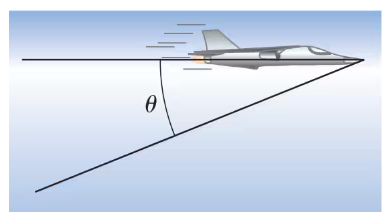
You look directly overhead and see a plane exactly 1.45 km above the ground flying faster than the speed of sound. By the time you hear the sonic boom, the plane has traveled a horizontal distance of 2.0 km. See Fig. 16–40. Determine (a) the angle of the shock cone, θ, and (b) the speed of the plane and its Mach number. Assume the speed of sound is 330 m/s.
Illustration of a supersonic plane creating a shock cone, with angle θ marked, depicting sonic boom dynamics.

Verified step by step guidance
1
Step 1: Understand the geometry of the shock cone. The angle θ of the shock cone is determined by the relationship between the vertical distance (1.45 km) and the horizontal distance (2.0 km) traveled by the plane. This forms a right triangle where θ is the angle opposite the vertical side.
Step 2: Use trigonometry to calculate the angle θ. Specifically, the tangent function relates the opposite side (vertical distance) to the adjacent side (horizontal distance). The formula is tan(θ) = opposite/adjacent. Substitute the values: tan(θ) = 1.45 km / 2.0 km.
Step 3: To find the speed of the plane, recognize that the Mach number is defined as the ratio of the speed of the plane to the speed of sound. The Mach number can also be related to the sine of the shock cone angle: Mach number = 1/sin(θ).
Step 4: Calculate the speed of the plane using the Mach number and the given speed of sound. Rearrange the formula: speed of plane = Mach number × speed of sound. Substitute the values for Mach number and the speed of sound (330 m/s).
Step 5: Convert the speed of the plane into km/h if needed for interpretation. Use the conversion factor: 1 m/s = 3.6 km/h. Multiply the plane's speed in m/s by 3.6 to express the result in km/h.

Key Concepts

Here are the essential concepts you must grasp in order to answer the question correctly.

Sonic Boom

A sonic boom occurs when an object travels through the air at a speed greater than the speed of sound, creating shock waves. These shock waves compress the air in front of the object, leading to a sudden change in pressure that is heard as a loud noise when the waves reach an observer. The phenomenon is a direct result of the object breaking the sound barrier.
Recommended video:
Guided course
08:28
Torque on Discs & Pulleys

Mach Number

The Mach number is a dimensionless quantity representing the ratio of the speed of an object to the speed of sound in the surrounding medium. It is used to classify the speed of aircraft: subsonic (Mach < 1), transonic (Mach ≈ 1), supersonic (1 < Mach < 5), and hypersonic (Mach > 5). Understanding Mach number is crucial for analyzing the behavior of objects moving at high speeds.
Recommended video:
Guided course
07:19
Moles & Avogadro's Number

Shock Cone

The shock cone is the conical region formed behind a supersonic object, where the pressure and density of the air change abruptly due to the shock waves produced. The angle of the shock cone, denoted as θ, can be calculated using the Mach number and is essential for understanding the spatial distribution of the sonic boom. The geometry of the shock cone influences how and when the sonic boom is perceived by observers on the ground.
Recommended video: