Ch. 16 - Sound
Giancoli Douglas - Physics for Scientists and Engineers 5th edition
Giancoli Douglas5th editionPhysics for Scientists and EngineersISBN: 9780137488179Not the one you use?Change textbook
Chapter 16, Problem 104b

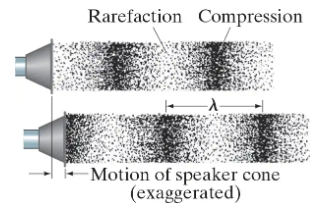
Assuming that the maximum displacement of the air molecules in a sound wave is about the same as that of the speaker cone that produces the sound (Fig. 16–46), estimate by how much a loudspeaker cone moves for a fairly loud (105 dB) sound of 35 Hz.

Verified step by step guidance
1
Understand the relationship between sound intensity and displacement amplitude. The sound intensity level (in decibels) is related to the displacement amplitude of the sound wave. The formula for sound intensity is: \( I = \frac{1}{2} \rho v \omega^2 s^2 \), where \( \rho \) is the air density, \( v \) is the speed of sound, \( \omega \) is the angular frequency, and \( s \) is the displacement amplitude.
Convert the given sound intensity level (105 dB) into actual intensity \( I \). Use the formula: \( L = 10 \log_{10} \left( \frac{I}{I_0} \right) \), where \( L \) is the sound level in decibels, \( I \) is the intensity, and \( I_0 = 10^{-12} \, \text{W/m}^2 \) is the reference intensity. Rearrange to solve for \( I \): \( I = I_0 \cdot 10^{L/10} \).
Determine the angular frequency \( \omega \) of the sound wave. The angular frequency is related to the frequency \( f \) by the formula: \( \omega = 2 \pi f \). Substitute \( f = 35 \; \text{Hz} \) to calculate \( \omega \).
Rearrange the intensity formula to solve for the displacement amplitude \( s \). From \( I = \frac{1}{2} \rho v \omega^2 s^2 \), isolate \( s \): \( s = \sqrt{\frac{2I}{\rho v \omega^2}} \). Here, \( \rho \) is the density of air (approximately \( 1.21 \; \text{kg/m}^3 \)), and \( v \) is the speed of sound in air (approximately \( 343 \; \text{m/s} \)).
Substitute the known values for \( I \), \( \rho \), \( v \), and \( \omega \) into the formula for \( s \). Perform the calculations to estimate the displacement amplitude \( s \), which corresponds to the movement of the loudspeaker cone.

Verified video answer for a similar problem:

This video solution was recommended by our tutors as helpful for the problem above.
Video duration:
7m
Was this helpful?

Key Concepts

Here are the essential concepts you must grasp in order to answer the question correctly.

Sound Intensity and Decibels

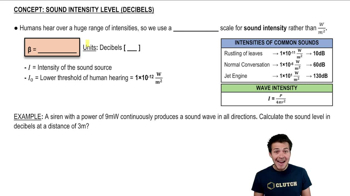
Sound intensity is a measure of the power per unit area carried by a sound wave. The decibel (dB) scale quantifies sound intensity logarithmically, where an increase of 10 dB represents a tenfold increase in intensity. A sound level of 105 dB indicates a relatively loud sound, which can be associated with significant energy transfer in the medium, affecting the displacement of air molecules.
Recommended video:
Guided course
04:25
Sound Intensity Level and the Decibel Scale

Frequency and Wavelength

Frequency refers to the number of oscillations or cycles of a wave that occur in one second, measured in hertz (Hz). In sound waves, frequency determines the pitch of the sound; lower frequencies correspond to deeper sounds. The relationship between frequency and wavelength is inversely proportional, meaning that as frequency decreases, the wavelength increases, which is crucial for understanding how sound waves propagate.
Recommended video:
Guided course
05:08
Circumference, Period, and Frequency in UCM

Amplitude and Displacement

Amplitude is the maximum extent of a vibration or oscillation, measured from the position of equilibrium. In the context of sound waves, amplitude relates to the loudness of the sound; greater amplitude results in louder sounds. The displacement of the loudspeaker cone directly influences the amplitude of the sound wave produced, which in turn affects the maximum displacement of air molecules in the wave.
Recommended video:
Guided course
06:13
Displacement vs. Distance