
Textbook Question
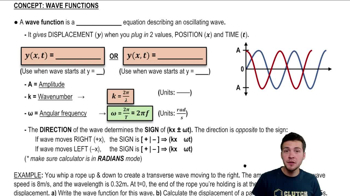
The displacement of a standing wave on a string is given by D = 2.4sin(0.60x)cos(42t), where x and D are in centimeters and t is in seconds. Give the amplitude, frequency, and speed of each of the component waves.
1
views

 Verified step by step guidance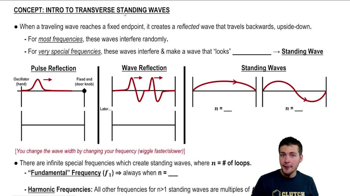
 07:58
07:58
 08:30
08:30 05:08
05:08The displacement of a standing wave on a string is given by D = 2.4sin(0.60x)cos(42t), where x and D are in centimeters and t is in seconds. Give the amplitude, frequency, and speed of each of the component waves.
When you slosh the water back and forth in a tub at just the right frequency, the water alternately rises and falls at each end, remaining relatively calm at the center. Suppose the frequency to produce such a standing wave in a 45-cm-wide tub is 0.85 Hz. What is the speed of the water wave?
(II) For any type of wave that reaches a boundary beyond which its speed is increased, there is a maximum incident angle if there is to be a transmitted refracted wave. This maximum incident angle θiM corresponds to an angle of refraction equal to 90°. If θᵢ > θiM, all the wave is reflected at the boundary and none is refracted, because this would correspond to sin θᵣ > 1 (where is the angle θᵣ of refraction), which is impossible.
(a) Find a formula for θiM using the law of refraction, Eq. 15–19.
A particular violin string plays at a frequency of 294 Hz. If the tension is increased 22%, what will the new frequency be?
A longitudinal earthquake wave strikes a boundary between two types of rock at a 41° angle. As the wave crosses the boundary, the specific gravity of the rock changes from 3.6 to 2.8. Assuming that the elastic modulus (Section 15–2)is the same for both types of rock, determine the angle of refraction.
The displacement of a standing wave on a string is given by D = 2.4 sin ( 0.60x ) cos (42t) , where x and D are in centimeters and t is in seconds. What is the distance (cm) between nodes?