
Ch. 15 - Wave Motion
Giancoli Douglas - Physics for Scientists and Engineers 5th edition
Giancoli Douglas5th editionPhysics for Scientists and EngineersISBN: 9780137488179Not the one you use?Change textbook
Chapter 15, Problem 55b

The displacement of a standing wave on a string is given by D = 2.4sin(0.60x)cos(42t), where x and D are in centimeters and t is in seconds. Give the amplitude, frequency, and speed of each of the component waves.

Verified step by step guidance
1
The given equation for the standing wave is \( D = 2.4 \sin(0.60x) \cos(42t) \). This represents a standing wave formed by the superposition of two traveling waves. To analyze the component waves, we need to rewrite the equation in terms of traveling waves using the trigonometric identity \( \sin(A)\cos(B) = \frac{1}{2}[\sin(A+B) + \sin(A-B)] \).
Using the identity, rewrite the equation as \( D = 1.2[\sin(0.60x + 42t) + \sin(0.60x - 42t)] \). This shows that the standing wave is the result of two traveling waves with equal amplitudes of 1.2 cm, traveling in opposite directions.
The amplitude of each component wave is 1.2 cm, as seen from the rewritten equation. This is half the amplitude of the standing wave (2.4 cm).
The angular frequency \( \omega \) of the component waves is given as 42 rad/s. To find the frequency \( f \), use the relation \( f = \frac{\omega}{2\pi} \). Substitute \( \omega = 42 \) rad/s to calculate \( f \).
The wave number \( k \) is given as 0.60 rad/cm. The speed \( v \) of the component waves can be found using the wave equation \( v = \frac{\omega}{k} \). Substitute \( \omega = 42 \) rad/s and \( k = 0.60 \) rad/cm to calculate \( v \).

Verified video answer for a similar problem:

This video solution was recommended by our tutors as helpful for the problem above.
Video duration:
5m
Was this helpful?

Key Concepts

Here are the essential concepts you must grasp in order to answer the question correctly.

Standing Waves

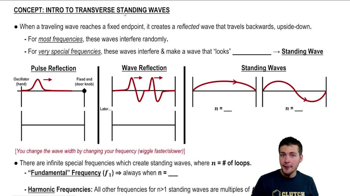
Standing waves are formed by the interference of two waves traveling in opposite directions with the same frequency and amplitude. They are characterized by nodes, where there is no displacement, and antinodes, where the displacement is maximum. The equation for a standing wave typically combines sine and cosine functions, representing the spatial and temporal components of the wave.
Recommended video:
Guided course
07:58
Intro to Transverse Standing Waves

Amplitude

Amplitude refers to the maximum displacement of points on a wave from their rest position. In the context of the given wave equation, the amplitude can be identified as the coefficient of the sine function, which indicates how far the wave oscillates from its equilibrium position. For the standing wave described, the amplitude is 2.4 cm.
Recommended video:
Guided course
04:24
Amplitude Decay in an LRC Circuit

Frequency and Wave Speed

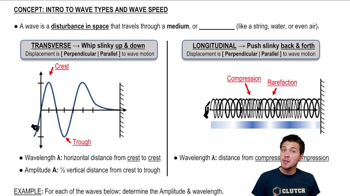
Frequency is the number of cycles of a wave that occur in a unit of time, typically measured in hertz (Hz). In the wave equation, the term associated with time (cos(42t)) indicates the angular frequency, which can be converted to frequency using the formula f = ω/(2π). Wave speed is determined by the product of frequency and wavelength, and can be calculated once the frequency and the spatial component of the wave are understood.
Recommended video:
Guided course
07:19
Intro to Waves and Wave Speed