

Ch. 14 - Oscillations
Giancoli Douglas - Physics for Scientists and Engineers 5th edition
Giancoli Douglas5th editionPhysics for Scientists and EngineersISBN: 9780137488179Not the one you use?Change textbook
Chapter 14, Problem 37a

At t = 0, an 885-g mass at rest on the end of a horizontal spring (k = 184 N/m) is struck by a hammer which gives it an initial speed of 2.12 m/s. Determine the period and frequency of the motion.

Verified step by step guidance
1
Convert the mass of the object from grams to kilograms, as SI units require mass in kilograms. Use the conversion: \( m = 885 \; \text{g} = 0.885 \; \text{kg} \).
Recall the formula for the angular frequency of a spring-mass system: \( \omega = \sqrt{\frac{k}{m}} \), where \( k \) is the spring constant and \( m \) is the mass. Substitute \( k = 184 \; \text{N/m} \) and \( m = 0.885 \; \text{kg} \) into the formula.
Use the relationship between angular frequency and the period of motion: \( T = \frac{2\pi}{\omega} \). Substitute the value of \( \omega \) obtained in the previous step to calculate the period \( T \).
Determine the frequency of the motion using the relationship \( f = \frac{1}{T} \), where \( T \) is the period. Substitute the value of \( T \) to find \( f \).
Summarize the results: The period \( T \) represents the time it takes for one complete oscillation, and the frequency \( f \) represents the number of oscillations per second.

Verified video answer for a similar problem:

This video solution was recommended by our tutors as helpful for the problem above.
Video duration:
3m
Was this helpful?

Key Concepts

Here are the essential concepts you must grasp in order to answer the question correctly.

Simple Harmonic Motion (SHM)

Simple Harmonic Motion is a type of periodic motion where an object oscillates around an equilibrium position. In this case, the mass attached to the spring will move back and forth due to the restoring force exerted by the spring, which is proportional to the displacement from the equilibrium position. Understanding SHM is crucial for analyzing the motion of the mass-spring system.
Recommended video:
Guided course
07:52
Simple Harmonic Motion of Pendulums

Period and Frequency

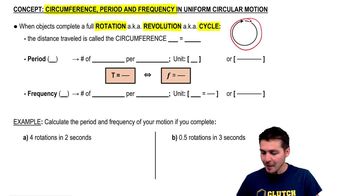
The period of a motion is the time it takes to complete one full cycle, while frequency is the number of cycles per unit time, typically measured in Hertz (Hz). For a mass-spring system undergoing SHM, the period (T) can be calculated using the formula T = 2π√(m/k), where m is the mass and k is the spring constant. Frequency (f) is the reciprocal of the period, f = 1/T.
Recommended video:
Guided course
05:08
Circumference, Period, and Frequency in UCM

Spring Constant (k)

The spring constant (k) is a measure of a spring's stiffness, defined as the force required to compress or extend the spring by a unit distance. In this problem, the spring constant is given as 184 N/m, indicating how much force is needed to stretch or compress the spring. This value is essential for calculating the period of oscillation in the mass-spring system.
Recommended video:
Guided course
08:59
Phase Constant of a Wave Function
Related Practice
Textbook Question

Agent Arlene devised the following method of measuring the muzzle velocity of a rifle (Fig. 14–34). She fires a bullet into a 4.148-kg wooden block resting on a smooth surface, and attached to a spring of spring constant k = 162.7 N/m. The bullet, whose mass is 7.450 g, remains embedded in the wooden block. She measures the maximum distance that the block compresses the spring to be 9.460 cm. What is the speed υ of the bullet?

Textbook Question

What is the period of a simple pendulum 47 cm long when it is in a freely falling elevator?

1
views
Textbook Question

An 1150-kg automobile has springs with k = 14,000 N/m. One of the tires is not properly balanced; it has a little extra mass on one side compared to the other, causing the car to shake at certain speeds. If the tire radius is 42 cm, at what speed will the wheel shake most?

1
views
Textbook Question

A mass resting on a horizontal, frictionless surface is attached to one end of a spring; the other end of the spring is fixed to a wall. It takes 3.2 J of work to compress the spring by 0.13 m. The mass is then released from rest and experiences a maximum acceleration of 12m/s². Find the value of the spring constant.

1
views
Textbook Question

A clock pendulum oscillates at a frequency of 2.5 Hz. At t = 0, it is released from rest starting at an angle of 12° to the vertical. Ignoring friction, what will be the position (angle in radians) of the pendulum at t = 0.25 s?

1
views
Textbook Question

An object with mass 2.7 kg is executing simple harmonic motion, attached to a spring with spring constant k = 310 N/m. When the object is 0.020 m from its equilibrium position, it is moving with a speed of 0.60 m/s. Calculate the maximum speed attained by the object.

1
views