Ch. 14 - Oscillations
Giancoli Douglas - Physics for Scientists and Engineers 5th edition
Giancoli Douglas5th editionPhysics for Scientists and EngineersISBN: 9780137488179Not the one you use?Change textbook
Chapter 14, Problem 35a

A mass resting on a horizontal, frictionless surface is attached to one end of a spring; the other end of the spring is fixed to a wall. It takes 3.2 J of work to compress the spring by 0.13 m. The mass is then released from rest and experiences a maximum acceleration of 12m/s². Find the value of the spring constant.

Verified step by step guidance
1
Step 1: Recall the formula for the work done on a spring, which is given by \( W = \frac{1}{2} k x^2 \), where \( W \) is the work done, \( k \) is the spring constant, and \( x \) is the compression or extension of the spring. Here, \( W = 3.2 \; \text{J} \) and \( x = 0.13 \; \text{m} \). Rearrange the formula to solve for \( k \): \( k = \frac{2W}{x^2} \).
Step 2: Substitute the given values into the formula. Use \( W = 3.2 \; \text{J} \) and \( x = 0.13 \; \text{m} \). The equation becomes \( k = \frac{2(3.2)}{(0.13)^2} \).
Step 3: Simplify the denominator \( (0.13)^2 \) and the numerator \( 2(3.2) \). Then divide the numerator by the denominator to find the spring constant \( k \).
Step 4: Verify the units of \( k \). Since work \( W \) is in joules (\( \text{kg} \cdot \text{m}^2 / \text{s}^2 \)) and \( x \) is in meters, the units of \( k \) will be \( \text{N/m} \), which is consistent with the spring constant's unit.
Step 5: Conclude that the spring constant \( k \) has been determined using the given data and the work-energy relationship for a spring.

Verified video answer for a similar problem:

This video solution was recommended by our tutors as helpful for the problem above.
Video duration:
2m
Was this helpful?

Key Concepts

Here are the essential concepts you must grasp in order to answer the question correctly.

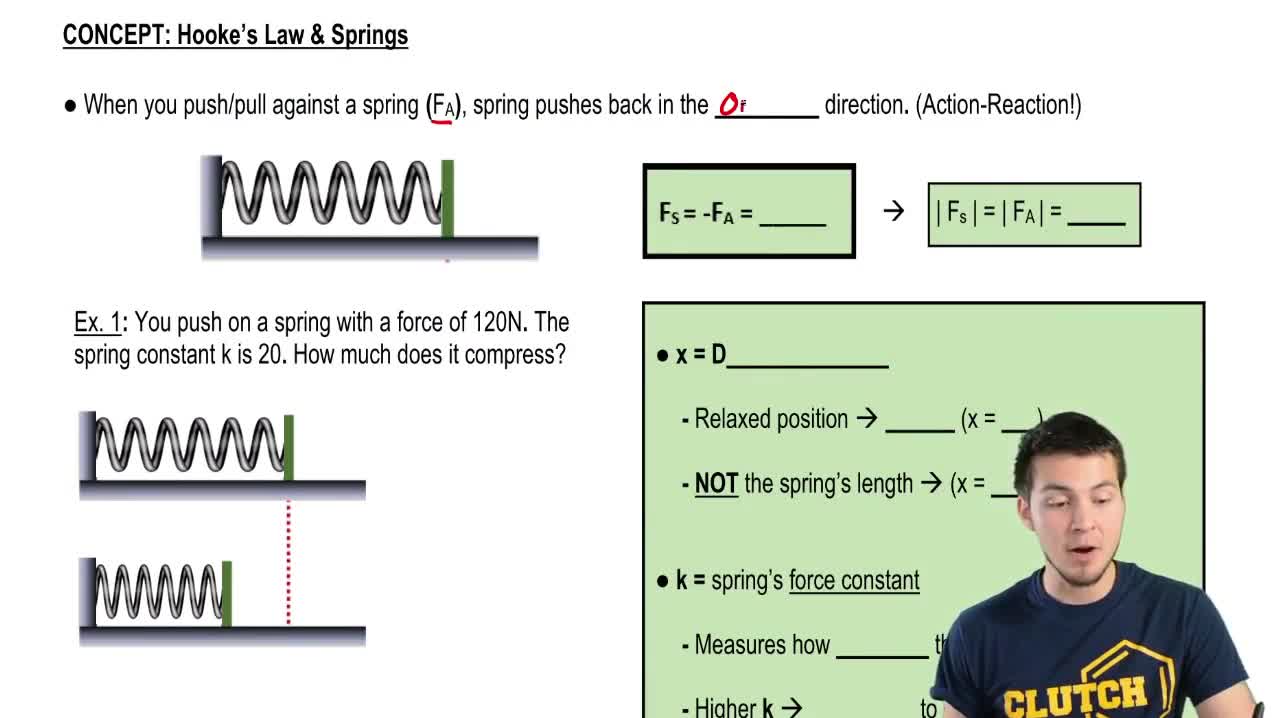
Hooke's Law

Hooke's Law states that the force exerted by a spring is directly proportional to its displacement from the equilibrium position, expressed as F = -kx, where F is the force, k is the spring constant, and x is the displacement. This principle is fundamental in understanding how springs behave under compression or extension.
Recommended video:
Guided course
05:27
Spring Force (Hooke's Law)

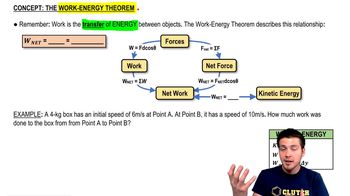
Work-Energy Principle

The Work-Energy Principle states that the work done on an object is equal to the change in its kinetic energy. In the context of the spring, the work done to compress it is stored as potential energy, which is converted into kinetic energy when the mass is released, allowing us to relate work, energy, and motion.
Recommended video:
Guided course
04:10
The Work-Energy Theorem

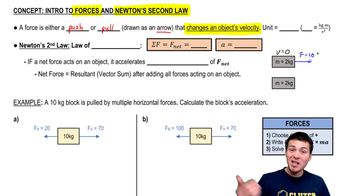
Acceleration and Newton's Second Law

Newton's Second Law relates the acceleration of an object to the net force acting on it and its mass, expressed as F = ma. In this scenario, the maximum acceleration experienced by the mass can be used to determine the net force exerted by the spring, which is crucial for calculating the spring constant using the relationship between force, displacement, and the spring's properties.
Recommended video:
Guided course
06:54
Intro to Forces & Newton's Second Law