
Ch. 10 - Rotational Motion
Giancoli Douglas - Physics for Scientists and Engineers 5th edition
Giancoli Douglas5th editionPhysics for Scientists and EngineersISBN: 9780137488179Not the one you use?Change textbook
Chapter 10, Problem 45a

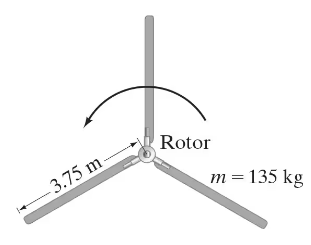
Let us treat a helicopter rotor blade as a long thin rod, as shown in Fig. 10–60. If each of the three rotor helicopter blades is 3.75 m long and has a mass of 135 kg, calculate the moment of inertia of the three rotor blades about the axis of rotation.
Diagram of a helicopter rotor with three blades, each 3.75 m long and 135 kg, illustrating rotational motion.

Verified step by step guidance
1
The moment of inertia for a single thin rod rotating about one end is given by the formula: I=13mL2, where m is the mass of the rod and L is its length.
Substitute the given values for a single blade: m=135 kg and L=3.75 m into the formula. This gives the moment of inertia for one blade as: I=13(135)(3.752).
Since there are three identical blades, the total moment of inertia is the sum of the moments of inertia of all three blades. This can be expressed as: Itotal=3×I, where I is the moment of inertia of one blade.
Substitute the calculated value of I for one blade into the total moment of inertia formula to find the total moment of inertia of the three blades.
Simplify the expression to obtain the final value for the total moment of inertia. Ensure the units are consistent and the result is expressed in kg·m².

Verified video answer for a similar problem:

This video solution was recommended by our tutors as helpful for the problem above.
Video duration:
3m
Was this helpful?

Key Concepts

Here are the essential concepts you must grasp in order to answer the question correctly.

Moment of Inertia

Moment of inertia is a measure of an object's resistance to changes in its rotational motion. It depends on the mass distribution relative to the axis of rotation. For a thin rod rotating about one end, the moment of inertia can be calculated using the formula I = (1/3)ml², where m is the mass and l is the length of the rod.
Recommended video:
Guided course
11:47
Intro to Moment of Inertia

Parallel Axis Theorem

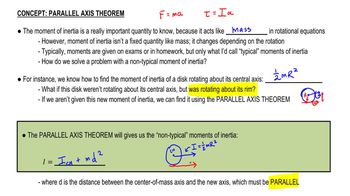
The parallel axis theorem allows us to calculate the moment of inertia of an object about any axis parallel to an axis through its center of mass. It states that I = I_cm + md², where I_cm is the moment of inertia about the center of mass, m is the mass, and d is the distance between the two axes. This theorem is useful when dealing with multiple objects or components.
Recommended video:
Guided course
13:46
Parallel Axis Theorem

Rotational Dynamics

Rotational dynamics is the study of the effects of forces and torques on the motion of rotating bodies. It encompasses concepts such as angular velocity, angular acceleration, and the relationship between torque and moment of inertia. Understanding these principles is essential for analyzing the motion of objects like helicopter rotor blades.
Recommended video:
Guided course
08:12
Torque & Acceleration (Rotational Dynamics)
Related Practice
Textbook Question

To get a flat, uniform cylindrical satellite spinning at the correct rate, engineers fire four tangential rockets as shown in Fig. 10–61. Suppose that the satellite has a mass of 3600 kg and a radius of 4.0 m, and that the rockets each add a mass of 250 kg. What is the steady force required of each rocket if the satellite is to reach 28 rpm in 5.0 min, starting from rest?

1
views
Textbook Question

Two blocks are connected by a light string passing over a pulley of radius 0.15 m and moment of inertia I. The blocks move (towards the right) with an acceleration of 1.00 m/s² along their frictionless inclines (see Fig. 10–62). Find the net torque acting on the pulley, and determine its moment of inertia, I.

Textbook Question

Calculate the moment of inertia of the array of point objects shown in Fig. 10–58 about the y axis, and the x axis. Assume m = 22kg, M = 3.2kg, and the objects are wired together by very light, rigid pieces of wire. The array is rectangular and is split through the middle by the x axis. About which axis would it be harder to accelerate this array?

1
views
Textbook Question

Suppose the force Fₜ in the cord hanging from the pulley of Example 10–10, Fig. 10–22, is given by the relation Fₜ = 3.00 t ― 0.20 t² (newtons) where t is in seconds. If the pulley starts from rest, what is the linear speed of a point on its rim 9.0 s later? Ignore friction and use the moment of inertia, calculated in Example 10–10.

2
views
Textbook Question

A softball player swings a bat, accelerating it from rest to 2.4 rev/s in a time of 0.20 s. Approximate the bat as a 0.90-kg uniform rod of length 0.95 m, and compute the torque the player applies to one end of it.

1
views
Textbook Question

A dad pushes tangentially on a small hand-driven merry-go-round and is able to accelerate it from rest to a frequency of 15 rpm in 10.0 s. Assume the merry-go-round is a uniform disk of radius 2.5 m and has a mass of 330 kg, and two children (each with a mass of 25 kg) sit opposite each other on the edge. Calculate the torque required to produce the acceleration, neglecting frictional torque. What force is required at the edge?

1
views