
Let us treat a helicopter rotor blade as a long thin rod, as shown in Fig. 10–60. If each of the three rotor helicopter blades is 3.75 m long and has a mass of 135 kg, calculate the moment of inertia of the three rotor blades about the axis of rotation.
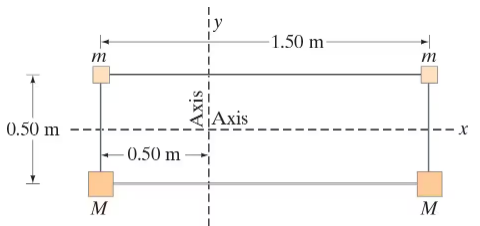
Calculate the moment of inertia of the array of point objects shown in Fig. 10–58 about the y axis, and the x axis. Assume m = 22kg, M = 3.2kg, and the objects are wired together by very light, rigid pieces of wire. The array is rectangular and is split through the middle by the x axis. About which axis would it be harder to accelerate this array?

Verified step by step guidance
Verified video answer for a similar problem:
Key Concepts
Moment of Inertia
Rotational Dynamics
Axis of Rotation
Determine the net torque on the 2.0-m-long uniform beam shown in Fig. 10–56. All forces are shown. Calculate about point P at one end.
Suppose the force Fₜ in the cord hanging from the pulley of Example 10–10, Fig. 10–22, is given by the relation Fₜ = 3.00 t ― 0.20 t² (newtons) where t is in seconds. If the pulley starts from rest, what is the linear speed of a point on its rim 9.0 s later? Ignore friction and use the moment of inertia, calculated in Example 10–10.
The forearm in Fig. 10–57 accelerates a 3.6-kg ball at 7.0 m/s² by means of the triceps muscle, as shown. Calculate the torque needed.
A softball player swings a bat, accelerating it from rest to 2.4 rev/s in a time of 0.20 s. Approximate the bat as a 0.90-kg uniform rod of length 0.95 m, and compute the torque the player applies to one end of it.
A dad pushes tangentially on a small hand-driven merry-go-round and is able to accelerate it from rest to a frequency of 15 rpm in 10.0 s. Assume the merry-go-round is a uniform disk of radius 2.5 m and has a mass of 330 kg, and two children (each with a mass of 25 kg) sit opposite each other on the edge. Calculate the torque required to produce the acceleration, neglecting frictional torque. What force is required at the edge?
