A gun fires a bullet vertically into a 1.40-kg block of wood at rest on a thin horizontal sheet, Fig. 9–54. If the bullet has a mass of 15.0 g and a speed of 230 m/s, how high will the block rise into the air after the bullet becomes embedded in it?
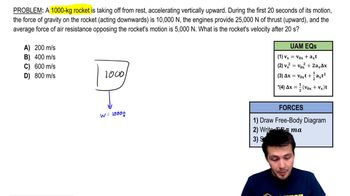
A rocket traveling 1950 m/s away from the Earth at an altitude of 6400 km fires its rockets, which eject gas at a speed of 1200 m/s (relative to the rocket). If the mass of the rocket at this moment is 25,000 kg and an acceleration of 1.5 m/s² is desired, at what rate must the gases be ejected?
Verified step by step guidance
Verified video answer for a similar problem:
Key Concepts
Rocket Propulsion
Thrust and Acceleration
Mass Flow Rate
A 0.145-kg baseball pitched horizontally at 35.0 m/s strikes a bat and pops straight up to a height of 31.5 m. If the contact time between bat and ball is 2.5 ms, calculate the average force between the ball and bat during contact.
The distance between a carbon atom (m = 12 u) and an oxygen atom (m = 16 u) in the CO molecule is 1.13 x 10⁻¹⁰ m. How far from the carbon atom is the center of mass of the molecule?
Find the center of mass of the ammonia molecule. The chemical formula is NH₃. The hydrogens are at the corners of an equilateral triangle (with sides 0.16 nm) that forms the base of a pyramid, with nitrogen at the apex (0.037 nm vertically above the plane of the triangle).
A 5.5-kg object moving in the +𝓍 direction at 6.5 m/s collides head-on with an 8.0-kg object moving in the ―𝓍 direction at 4.0 m/s. Determine the final velocity of each object if the objects stick together.
A huge balloon and its gondola, of mass M, are in the air and stationary with respect to the ground. A passenger, of mass m, then climbs out and slides down a rope with speed v, measured with respect to the balloon. With what speed and direction (relative to Earth) does the balloon then move? What happens if the passenger stops?
