
A 144-g baseball moving 28.0 m/s strikes a stationary 4.85-kg brick resting on small rollers so it moves without significant friction. After hitting the brick, the baseball bounces straight back, and the brick moves forward at 1.10 m/s. Find the total kinetic energy before and after the collision.
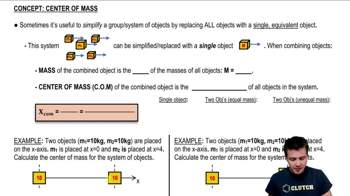
The distance between a carbon atom (m = 12 u) and an oxygen atom (m = 16 u) in the CO molecule is 1.13 x 10⁻¹⁰ m. How far from the carbon atom is the center of mass of the molecule?
Verified step by step guidance
Verified video answer for a similar problem:
Key Concepts
Center of Mass
Mass Units
Distance Measurement
A rocket traveling 1950 m/s away from the Earth at an altitude of 6400 km fires its rockets, which eject gas at a speed of 1200 m/s (relative to the rocket). If the mass of the rocket at this moment is 25,000 kg and an acceleration of 1.5 m/s² is desired, at what rate must the gases be ejected?
A bullet of mass m = 0.0010 kg embeds itself in a wooden block with mass M = 0.999 kg, which then compresses a spring (k = 140 N/m) by a distance 𝓍 = 0.050 m before coming to rest. The coefficient of kinetic friction between the block and table is μ = 0.50. What fraction of the bullet’s initial kinetic energy is dissipated (in damage to the wooden block, rising temperature, etc.) in the collision between the bullet and the block?
(II) A pendulum consists of a mass M hanging at the bottom end of a massless rod of length ℓ, which has a frictionless pivot at its top end. A mass m, moving horizontally as shown in Fig. 9–44 with velocity v, impacts M and becomes embedded. What is the smallest value of v sufficient to cause the pendulum (with embedded mass m) to swing clear over the top of its arc?
Find the center of mass of the ammonia molecule. The chemical formula is NH₃. The hydrogens are at the corners of an equilateral triangle (with sides 0.16 nm) that forms the base of a pyramid, with nitrogen at the apex (0.037 nm vertically above the plane of the triangle).
A huge balloon and its gondola, of mass M, are in the air and stationary with respect to the ground. A passenger, of mass m, then climbs out and slides down a rope with speed v, measured with respect to the balloon. With what speed and direction (relative to Earth) does the balloon then move? What happens if the passenger stops?
