
Textbook Question
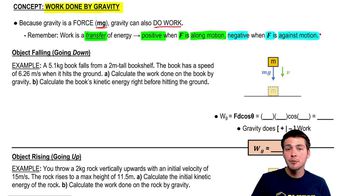
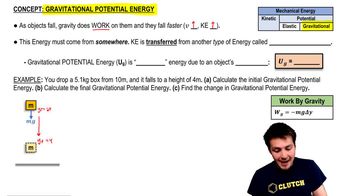
At room temperature, an oxygen molecule, with mass of 5.31 x 10⁻²⁶ kg, typically has a kinetic energy of about 6.21 x 10⁻²¹ J . How fast is it moving?
1
views

 Verified step by step guidance
 06:34
06:34
 06:35
06:35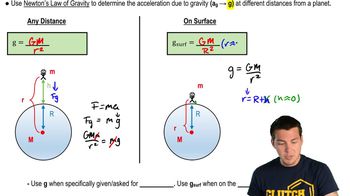 05:20
05:20At room temperature, an oxygen molecule, with mass of 5.31 x 10⁻²⁶ kg, typically has a kinetic energy of about 6.21 x 10⁻²¹ J . How fast is it moving?
A 3.5-kg object moving in two dimensions initially has a velocity = (10.0 î + 20.0 ĵ) m/s. A net force then acts on the object for 2.0 s, after which the object’s velocity is = (15.0 î + 30.0 ĵ) m/s. Determine the work done by on the object.
Consider a force F₁ = which acts on an object during its journey along the x axis from x = 0.0 to x = 1.0m, where A = 3.0 Nm¹⸍². Show that during this journey, even though F₁ is infinite at x = 0.0, the work W done on the object by this force is finite, and determine W.
A 3.0-m-long steel chain is stretched out along the top level of a horizontal scaffold at a construction site, in such a way that 2.0 m of the chain remains on the top level and 1.0 m hangs vertically, Fig. 7–27. At this point, the force on the hanging segment is sufficient to pull the entire chain over the edge. Once the chain is moving, the kinetic friction is so small that it can be neglected. How much work is performed on the chain by the force of gravity as the chain falls from the point where 2.0 m remains on the scaffold to the point where the entire chain has left the scaffold? (Assume that the chain has a linear weight density of 24 N/m.)
If the hill in Example 7–2 (Fig. 7–4) was not an even slope but rather an irregular curve as in Fig. 7–23, show that the same result would be obtained as in Example 7–2: namely, that the work done by gravity depends only on the height of the hill and not on its shape or the path taken.
The net force exerted on a particle acts in the positive x direction. Its magnitude increases linearly from zero at x = 0, to 380 N at x = 3.0m. It remains constant at 380 N from x = 3.0m to x = 7.0m, and then decreases linearly to zero at x = 12.0m. Determine the work done to move the particle from x = 0 to x = 12.0m graphically, by determining the area under the Fₓ versus x graph.