Ch. 07 - Work and Energy
Giancoli Douglas - Physics for Scientists and Engineers 5th edition
Giancoli Douglas5th editionPhysics for Scientists and EngineersISBN: 9780137488179Not the one you use?Change textbook
Chapter 7, Problem 54

At room temperature, an oxygen molecule, with mass of 5.31 x 10⁻²⁶ kg, typically has a kinetic energy of about 6.21 x 10⁻²¹ J . How fast is it moving?

Verified step by step guidance
1
Step 1: Recall the formula for the kinetic energy of an object: K=12mv2, where K is the kinetic energy, m is the mass, and v is the velocity.
Step 2: Rearrange the formula to solve for velocity v. Start by multiplying both sides of the equation by 2 to eliminate the fraction: 2K=mv2.
Step 3: Divide both sides of the equation by m to isolate v2: v2=2K/m.
Step 4: Take the square root of both sides to solve for v: v=2K/m.
Step 5: Substitute the given values for K (6.21 × 10⁻²¹ J) and m (5.31 × 10⁻²⁶ kg) into the formula and compute the result to find the velocity.

Verified video answer for a similar problem:

This video solution was recommended by our tutors as helpful for the problem above.
Video duration:
2m
Was this helpful?

Key Concepts

Here are the essential concepts you must grasp in order to answer the question correctly.

Kinetic Energy

Kinetic energy is the energy an object possesses due to its motion, calculated using the formula KE = 1/2 mv², where m is mass and v is velocity. In this context, the kinetic energy of the oxygen molecule is given, which allows us to determine its speed by rearranging the formula to solve for v.
Recommended video:
Guided course
06:07
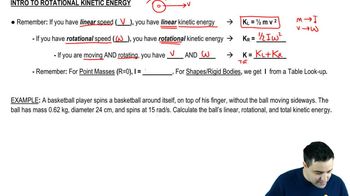
Intro to Rotational Kinetic Energy

Mass

Mass is a measure of the amount of matter in an object, typically expressed in kilograms. In this question, the mass of the oxygen molecule is provided as 5.31 x 10⁻²⁶ kg, which is essential for calculating its velocity using the kinetic energy formula.
Recommended video:
Guided course
20:32
Mass Spectrometers

Velocity

Velocity is a vector quantity that describes the speed of an object in a specific direction. In this scenario, we need to calculate the velocity of the oxygen molecule based on its kinetic energy and mass, which will provide insight into its motion at room temperature.
Recommended video:
Guided course
7:27
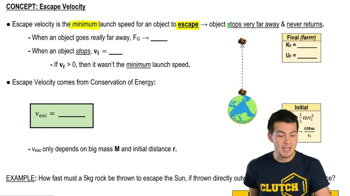
Escape Velocity
Related Practice
Textbook Question

A 2800-kg space vehicle, initially at rest, falls vertically from a height of 2900 km above the Earth’s surface. Determine how much work is done by the force of gravity in bringing the vehicle to the Earth’s surface.

2
views

Textbook Question

A 3.5-kg object moving in two dimensions initially has a velocity v1\(\overrightarrow{v_1}\)_{} = (10.0 î + 20.0 ĵ) m/s. A net force F\(\overrightarrow{F}\) then acts on the object for 2.0 s, after which the object’s velocity is v2\(\overrightarrow{v_2}\)_{} = (15.0 î + 30.0 ĵ) m/s. Determine the work done by F\(\overrightarrow{F}\) on the object.

1
views
Textbook Question

Consider a force F₁ = A/xA/\(\sqrt{x}\) which acts on an object during its journey along the x axis from x = 0.0 to x = 1.0m, where A = 3.0 Nm¹⸍². Show that during this journey, even though F₁ is infinite at x = 0.0, the work W done on the object by this force is finite, and determine W.

1
views
Textbook Question

A 3.0-m-long steel chain is stretched out along the top level of a horizontal scaffold at a construction site, in such a way that 2.0 m of the chain remains on the top level and 1.0 m hangs vertically, Fig. 7–27. At this point, the force on the hanging segment is sufficient to pull the entire chain over the edge. Once the chain is moving, the kinetic friction is so small that it can be neglected. How much work is performed on the chain by the force of gravity as the chain falls from the point where 2.0 m remains on the scaffold to the point where the entire chain has left the scaffold? (Assume that the chain has a linear weight density of 24 N/m.)

1
views
Textbook Question

A car traveling at a velocity v can stop in a minimum distance d. What would be the car’s minimum stopping distance if it were traveling at a velocity of 2v?

Textbook Question

The force required to compress an “imperfect” horizontal spring (doesn’t follow Hooke’s law) an amount x is given by F = 150x + 12x³, where x is in meters and F in newtons. If the spring is compressed 2.0 m, what speed will it give to a 3.0-kg ball held against it and then released?

1
views