Ch. 03 - Kinematics in Two or Three Dimensions; Vectors
Giancoli Douglas - Physics for Scientists and Engineers 5th edition
Giancoli Douglas5th editionPhysics for Scientists and EngineersISBN: 9780137488179Not the one you use?Change textbook
Chapter 3, Problem 7a

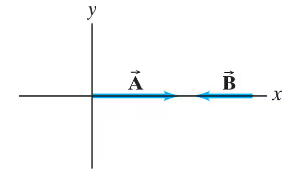
Figure 3–39 shows two vectors, A\(\overrightarrow{A}\) and B\(\overrightarrow{B}\), whose magnitudes are A = 6.8 units and B = 5.5 units. Determine C\(\overrightarrow{C}\) if C\(\overrightarrow{C}\) = A\(\overrightarrow{A}\) + B\(\overrightarrow{B}\). Give the magnitude and direction for each.
Two vectors A and B are shown on a Cartesian plane, with magnitudes labeled as 6.8 units and 5.5 units, respectively.

Verified step by step guidance
1
Step 1: Understand the problem. You are tasked with finding the resultant vector \( \vec{C} \) when \( \vec{C} = \vec{A} + \vec{B} \). This involves vector addition, and you need to determine both the magnitude and direction of \( \vec{C} \). The magnitudes of \( \vec{A} \) and \( \vec{B} \) are given as 6.8 units and 5.5 units, respectively. The directions of \( \vec{A} \) and \( \vec{B} \) are implied in the figure (not provided here).
Step 2: Break down the vectors into components. Use trigonometry to resolve \( \vec{A} \) and \( \vec{B} \) into their x- and y-components. For a vector \( \vec{V} \) with magnitude \( V \) and angle \( \theta \) (measured from the positive x-axis): \( V_x = V \cos(\theta) \) and \( V_y = V \sin(\theta) \). Apply this formula to both \( \vec{A} \) and \( \vec{B} \).
Step 3: Add the components of \( \vec{A} \) and \( \vec{B} \) to find the components of \( \vec{C} \). Specifically, \( C_x = A_x + B_x \) and \( C_y = A_y + B_y \). This step combines the x-components and y-components of the two vectors to form the resultant vector \( \vec{C} \).
Step 4: Calculate the magnitude of \( \vec{C} \). Use the Pythagorean theorem: \( |\vec{C}| = \sqrt{C_x^2 + C_y^2} \). This gives the length of the resultant vector.
Step 5: Determine the direction of \( \vec{C} \). The direction (angle \( \theta_C \)) can be found using the inverse tangent function: \( \theta_C = \tan^{-1}(C_y / C_x) \). Ensure the angle is adjusted based on the quadrant in which \( \vec{C} \) lies.

Verified video answer for a similar problem:

This video solution was recommended by our tutors as helpful for the problem above.
Was this helpful?

Key Concepts

Here are the essential concepts you must grasp in order to answer the question correctly.

Vector Addition

Vector addition involves combining two or more vectors to determine a resultant vector. This process requires both the magnitudes and directions of the vectors. The resultant vector's magnitude can be found using the Pythagorean theorem if the vectors are perpendicular, or by using the law of cosines for non-perpendicular vectors. The direction of the resultant vector is determined by the angle it makes with a reference axis.
Recommended video:
Guided course
07:30
Vector Addition By Components

Magnitude of a Vector

The magnitude of a vector is a measure of its length or size, represented as a non-negative scalar quantity. It is calculated using the formula that involves the components of the vector, typically expressed in Cartesian coordinates. For example, for a vector A with components (Ax, Ay), the magnitude is given by |A| = √(Ax² + Ay²). Understanding magnitude is crucial for determining the overall strength of the vector in a physical context.
Recommended video:
Guided course
03:59
Calculating Magnitude & Components of a Vector

Direction of a Vector

The direction of a vector indicates the orientation of the vector in space, often described by an angle relative to a reference direction, such as the positive x-axis. It can be expressed in degrees or radians and is essential for understanding how vectors interact in a given problem. The direction can be determined using trigonometric functions, such as sine and cosine, based on the vector's components.
Recommended video:
Guided course
06:44
Adding 3 Vectors in Unit Vector Notation