Ch. 03 - Kinematics in Two or Three Dimensions; Vectors
Giancoli Douglas - Physics for Scientists and Engineers 5th edition
Giancoli Douglas5th editionPhysics for Scientists and EngineersISBN: 9780137488179Not the one you use?Change textbook
Chapter 3, Problem 8a

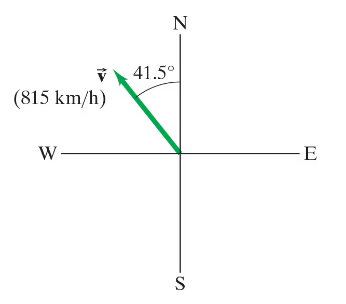
An airplane is traveling 815 km/h in a direction 41.5° west of north (Fig. 3–40). Find the components of the velocity vector in the northerly and westerly directions.
Green vector arrow indicating an airplane's velocity of 815 km/h at 41.5° west of north on a compass rose.

Verified step by step guidance
1
Start by identifying the given values: the speed of the airplane is 815 km/h, and the direction is 41.5° west of north. This means the velocity vector forms an angle of 41.5° with the northward direction.
To find the components of the velocity vector, use trigonometric functions. The northerly component (V_north) is given by the formula: Vnorth=Vcos(θ), where V is the magnitude of the velocity (815 km/h) and θ is the angle (41.5°).
Similarly, the westerly component (V_west) is given by the formula: Vwest=Vsin(θ), where V is the magnitude of the velocity (815 km/h) and θ is the angle (41.5°).
Substitute the given values into the formulas: for the northerly component, use Vnorth=815cos(41.5°), and for the westerly component, use Vwest=815sin(41.5°).
Finally, calculate the cosine and sine of 41.5° and multiply by 815 km/h to find the numerical values of the northerly and westerly components. Ensure your calculator is set to degrees when performing these calculations.

Verified video answer for a similar problem:

This video solution was recommended by our tutors as helpful for the problem above.
Was this helpful?

Key Concepts

Here are the essential concepts you must grasp in order to answer the question correctly.

Velocity Vector

A velocity vector represents both the speed and direction of an object's motion. In this case, the airplane's velocity is given as 815 km/h at an angle of 41.5° west of north. Understanding how to break down this vector into its components is essential for analyzing its motion in different directions.
Recommended video:
Guided course
06:44
Adding 3 Vectors in Unit Vector Notation

Vector Components

Vector components are the projections of a vector along the axes of a coordinate system, typically represented as horizontal (x-axis) and vertical (y-axis) components. For the airplane's velocity, we need to calculate the northerly and westerly components using trigonometric functions, specifically sine and cosine, based on the given angle.
Recommended video:
Guided course
07:30
Vector Addition By Components

Trigonometric Functions

Trigonometric functions, such as sine and cosine, relate the angles of a triangle to the ratios of its sides. In this context, they are used to determine the components of the velocity vector. The cosine function helps find the adjacent side (northerly component), while the sine function finds the opposite side (westerly component) based on the angle provided.
Recommended video:
Guided course
08:30
Intro to Wave Functions