
Ch. 03 - Kinematics in Two or Three Dimensions; Vectors
Giancoli Douglas - Physics for Scientists and Engineers 5th edition
Giancoli Douglas5th editionPhysics for Scientists and EngineersISBN: 9780137488179Not the one you use?Change textbook
Chapter 3, Problem 65b

A motorboat whose speed in still water is 4.30 m/s must aim upstream at an angle of 23.5° (with respect to a line perpendicular to the shore) in order to travel directly across the stream. What is the resultant speed of the boat with respect to the shore? (See Fig. 3–33.)

Verified step by step guidance
1
Identify the key components of the problem: The motorboat's speed in still water is 4.30 m/s, the angle it makes with the perpendicular to the shore is 23.5°, and the goal is to find the resultant speed of the boat with respect to the shore.
Break the boat's velocity into components: The velocity of the boat in still water can be resolved into two components using trigonometry. The component perpendicular to the shore is \( v_{b,\perp} = v_b \cos(23.5°) \), and the component parallel to the shore (opposing the stream's flow) is \( v_{b,\parallel} = v_b \sin(23.5°) \), where \( v_b = 4.30 \; \text{m/s} \).
Account for the stream's velocity: The stream's velocity affects the boat's motion parallel to the shore. Let the stream's velocity be \( v_s \). The net velocity parallel to the shore is \( v_{\text{net,parallel}} = v_{b,\parallel} - v_s \).
Determine the resultant velocity: The resultant velocity of the boat with respect to the shore is the vector sum of the perpendicular and parallel components. Use the Pythagorean theorem: \( v_{\text{resultant}} = \sqrt{v_{b,\perp}^2 + v_{\text{net,parallel}}^2} \).
Substitute the known values: Substitute \( v_b = 4.30 \; \text{m/s} \), \( \cos(23.5°) \), and \( \sin(23.5°) \) into the equations for \( v_{b,\perp} \) and \( v_{b,\parallel} \). Then, calculate \( v_{\text{resultant}} \) using the Pythagorean theorem. Note that the stream's velocity \( v_s \) must be known or provided to complete the calculation.

Verified video answer for a similar problem:

This video solution was recommended by our tutors as helpful for the problem above.
Video duration:
3m
Was this helpful?

Key Concepts

Here are the essential concepts you must grasp in order to answer the question correctly.

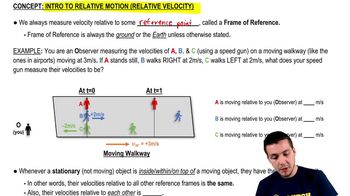
Relative Velocity

Relative velocity is the velocity of an object as observed from a particular reference frame. In this scenario, the motorboat's speed in still water is affected by the current of the stream, necessitating an understanding of how to combine these velocities to find the resultant speed with respect to the shore.
Recommended video:
Guided course
04:27
Intro to Relative Motion (Relative Velocity)

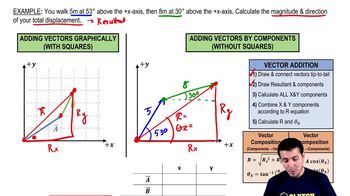
Vector Addition

Vector addition is the process of combining two or more vectors to determine a resultant vector. In this case, the boat's velocity vector and the river's current vector must be added using trigonometric methods to find the boat's overall speed and direction relative to the shore.
Recommended video:
Guided course
07:30
Vector Addition By Components

Trigonometric Functions

Trigonometric functions, such as sine and cosine, relate the angles and sides of triangles. They are essential for resolving the boat's velocity into its components, allowing for the calculation of the resultant speed when the boat is aimed at an angle upstream against the current.
Recommended video:
Guided course
08:30
Intro to Wave Functions
Related Practice
Textbook Question

Two cars approach a street corner at right angles to each other (Fig. 3–57). Car 1 travels at a speed relative to Earth v₁ₑ = 35 km/h, and car 2 at v₂ₑ = 55 km/h. What is the relative velocity of car 1 as seen by car 2? What is the velocity of car 2 relative to car 1?

1
views
Textbook Question

A stunt driver wants to make his car jump over 8 cars parked side by side below a horizontal ramp (Fig. 3–46). With what minimum speed must he drive off the horizontal ramp? The vertical height of the ramp is 1.5 m above the car roofs and the horizontal distance he must clear is 22 m. 

<IMAGE>

2
views
Textbook Question

A person in the passenger basket of a hot-air balloon throws a ball horizontally outward from the basket with speed 12.0 m/s (Fig. 3–64). What initial velocity (magnitude and direction) does the ball have relative to a person standing on the ground if the hot-air balloon is descending at 3.0 m/s relative to the ground?

<IMAGE>

17
views
Textbook Question

At serve, a tennis player aims to hit the ball horizontally. What minimum speed is required for the ball to clear the 0.90-m-high net about 15.0 m from the server if the ball is 'launched' from a height of 2.30 m? Where will the ball land if it just clears the net (and will it be 'good' in the sense that it lands within 7.0 m of the net)? How long will it be in the air? See Fig. 3–50.

2
views
Textbook Question

A diver running 2.5 m/s dives out horizontally from the edge of a vertical cliff and 3.5 s later reaches the water below. How high was the cliff and how far from its base did the diver hit the water?

1
views