Ch. 02 - Describing Motion: Kinematics in One Dimension
Giancoli Douglas - Physics for Scientists and Engineers 5th edition
Giancoli Douglas5th editionPhysics for Scientists and EngineersISBN: 9780137488179Not the one you use?Change textbook
Chapter 2, Problem 60

For an object falling freely from rest, show that the distance traveled during each successive second increases in the ratio of successive odd integers (1, 3, 5, etc.). (This was first shown by Galileo.) See Figs. 2–27 and 2–30.

Verified step by step guidance
1
Start by recalling the kinematic equation for the distance traveled by an object under constant acceleration: s = v_0t + (1/2)at^2. Since the object is falling freely from rest, the initial velocity v_0 is 0, and the equation simplifies to s = (1/2)gt^2, where g is the acceleration due to gravity.
To find the distance traveled during each successive second, calculate the distance traveled at the end of time t and subtract the distance traveled at the end of time t-1. This gives the distance traveled in the t-th second: s_t = (1/2)g t^2 - (1/2)g (t-1)^2.
Simplify the expression for s_t: Expand the squares to get s_t = (1/2)g (t^2 - (t^2 - 2t + 1)). Simplify further to obtain s_t = (1/2)g (2t - 1), which represents the distance traveled during the t-th second.
Observe that the distance traveled during successive seconds is proportional to the sequence 2t - 1, which generates the odd integers: 1, 3, 5, etc., as t increases.
Conclude that the distance traveled during each successive second increases in the ratio of successive odd integers (1, 3, 5, etc.), as shown by Galileo. This result arises from the quadratic dependence of distance on time in uniformly accelerated motion.

Verified video answer for a similar problem:

This video solution was recommended by our tutors as helpful for the problem above.
Was this helpful?

Key Concepts

Here are the essential concepts you must grasp in order to answer the question correctly.

Free Fall

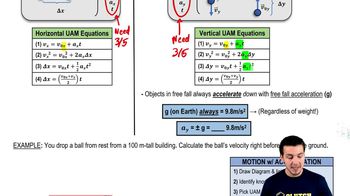
Free fall refers to the motion of an object under the influence of gravity alone, with no other forces acting on it, such as air resistance. In this scenario, the object accelerates downward at a constant rate, approximately 9.81 m/s² on Earth. Understanding free fall is crucial for analyzing the motion of objects in gravitational fields.
Recommended video:
Guided course
08:36
Vertical Motion & Free Fall

Distance Traveled in Free Fall

The distance traveled by an object in free fall can be calculated using the equation d = 1/2 g t², where d is the distance, g is the acceleration due to gravity, and t is the time in seconds. This equation shows that the distance increases with the square of the time, leading to greater distances covered in successive seconds.
Recommended video:
Guided course
08:36
Vertical Motion & Free Fall

Odd Integer Ratios

The concept of odd integer ratios arises from the distances covered in each second of free fall. Specifically, the distance traveled in the first second is 1 unit, in the second second is 3 units, and in the third second is 5 units, forming the sequence of odd integers. This pattern illustrates how the distance increases non-linearly, emphasizing the accelerating nature of free fall.
Recommended video:
Guided course
05:32
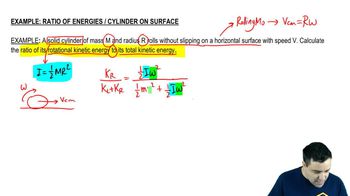
Ratio of energies of cylinder on surface