
Ch. 02 - Describing Motion: Kinematics in One Dimension
Giancoli Douglas - Physics for Scientists and Engineers 5th edition
Giancoli Douglas5th editionPhysics for Scientists and EngineersISBN: 9780137488179Not the one you use?Change textbook
Chapter 2, Problem 41c

A car traveling 85 km/h slows down at a constant 0.50 m/s² just by 'letting up on the gas.' Calculate the distance it travels during the first and fifth seconds.

Verified step by step guidance
1
Convert the car's initial velocity from km/h to m/s. Use the conversion factor: 1 km/h = 0.27778 m/s. The formula is: \( v_0 = 85 \times 0.27778 \).
Use the kinematic equation \( x = v_0 t + \frac{1}{2} a t^2 \) to calculate the distance traveled during the first second. Here, \( v_0 \) is the initial velocity, \( a \) is the acceleration (-0.50 m/s²), and \( t \) is the time (1 second).
To find the distance traveled during the fifth second, calculate the total distance traveled in 5 seconds using the same kinematic equation \( x = v_0 t + \frac{1}{2} a t^2 \). Then, calculate the total distance traveled in 4 seconds using the same equation. Subtract the distance traveled in 4 seconds from the distance traveled in 5 seconds to get the distance traveled during the fifth second.
Substitute the known values into the equations: \( v_0 \) (converted from step 1), \( a = -0.50 \ \text{m/s}^2 \), and \( t \) (1 second for the first second, and 5 seconds for the fifth second).
Simplify the expressions to find the distances for the first and fifth seconds. Remember to keep track of units and signs (negative acceleration indicates slowing down).

Verified video answer for a similar problem:

This video solution was recommended by our tutors as helpful for the problem above.
Was this helpful?

Key Concepts

Here are the essential concepts you must grasp in order to answer the question correctly.

Kinematics

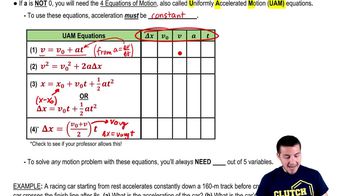
Kinematics is the branch of mechanics that deals with the motion of objects without considering the forces that cause the motion. It involves concepts such as displacement, velocity, acceleration, and time. In this problem, understanding kinematic equations is essential to calculate the distance traveled by the car during specific time intervals.
Recommended video:
Guided course
08:25
Kinematics Equations

Acceleration

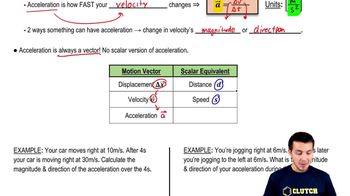
Acceleration is defined as the rate of change of velocity of an object with respect to time. It can be positive (speeding up) or negative (slowing down), as in this case where the car decelerates at a constant rate of 0.50 m/s². This concept is crucial for determining how the car's speed changes over time and affects the distance traveled.
Recommended video:
Guided course
05:47
Intro to Acceleration

Equations of Motion

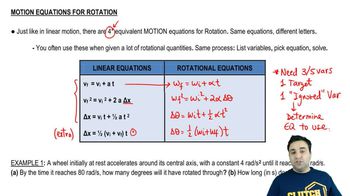
The equations of motion describe the relationship between an object's displacement, initial velocity, acceleration, and time. For uniformly accelerated motion, the equation s = ut + 0.5at² can be used, where s is the distance, u is the initial velocity, a is the acceleration, and t is the time. These equations are vital for calculating the distance the car travels during the specified seconds.
Recommended video:
Guided course
07:18
Equations of Rotational Motion