Ch. 01 - Introduction, Measurement, Estimating
Giancoli Douglas - Physics for Scientists and Engineers 5th edition
Giancoli Douglas5th editionPhysics for Scientists and EngineersISBN: 9780137488179Not the one you use?Change textbook
Chapter 1, Problem 52

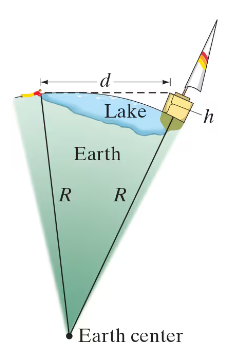
Many sailboats are docked at a marina 4.4 km away on the opposite side of a lake. You stare at one of the sailboats because, when you are lying flat at the water's edge, you can just see its deck but none of the side of the sailboat. You then go to that sailboat on the other side of the lake and measure that the deck is 1.5 m above the level of the water. Using Fig. 1–14, where h = 1.5 m , estimate the radius R of the Earth.
Diagram illustrating the relationship between a sailboat's height above water and the Earth's radius, with labeled components.

Verified step by step guidance
1
Understand the problem: The scenario involves estimating the radius of the Earth (R) using the curvature of the Earth and the fact that the deck of the sailboat is just visible when lying flat at the water's edge. This is a geometric optics problem involving the Earth's curvature.
Set up the geometry: The Earth is approximated as a sphere. The observer's line of sight is tangent to the Earth's surface at the point where the sailboat's deck is just visible. This forms a right triangle with the Earth's radius (R), the distance to the sailboat (d = 4.4 km), and the height of the sailboat's deck above the water (h = 1.5 m).
Apply the Pythagorean theorem: The relationship between the radius of the Earth (R), the distance to the sailboat (d), and the height of the sailboat's deck (h) is given by: d2 + R2 = R + h2.
Simplify the equation: Expand the right-hand side of the equation: d2 + R2 = R2 + 2Rh + h2. Cancel out R2 on both sides to get: d2 = 2Rh + h2.
Solve for R: Rearrange the equation to isolate R: R = d2 - h22h. Substitute the given values (d = 4.4 km = 4400 m, h = 1.5 m) into the equation to calculate the radius of the Earth.

Verified video answer for a similar problem:

This video solution was recommended by our tutors as helpful for the problem above.
Was this helpful?

Key Concepts

Here are the essential concepts you must grasp in order to answer the question correctly.

Curvature of the Earth

The Earth is not a perfect sphere but an oblate spheroid, meaning it curves away from a flat surface. This curvature affects how we perceive objects at a distance, such as the visibility of a sailboat's deck when lying flat at the water's edge. Understanding this curvature is essential for estimating the Earth's radius based on the height of objects above the water.
Recommended video:
Guided course
9:26
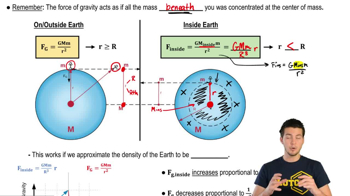
Gravitational Force Inside the Earth

Line of Sight

Line of sight refers to the straight line along which an observer can see an object. In this scenario, the observer's line of sight to the sailboat's deck is influenced by the Earth's curvature. The height of the deck above the water level determines how far away the observer can see the deck before it disappears from view due to the curvature.
Recommended video:
Guided course
08:20
Electric Field Lines

Geometry of a Circle

The geometry of a circle is fundamental in calculating the radius of the Earth. By applying the Pythagorean theorem and understanding the relationship between the height of the object and the distance to the horizon, one can derive the radius. This involves using the height of the sailboat's deck and the distance to the marina to estimate the Earth's radius.
Recommended video:
Guided course
10:19
Torque Due to Weight