Ch. 01 - Introduction, Measurement, Estimating
Giancoli Douglas - Physics for Scientists and Engineers 5th edition
Giancoli Douglas5th editionPhysics for Scientists and EngineersISBN: 9780137488179Not the one you use?Change textbook
Chapter 1, Problem 1g

How many significant figures does the following number have? 8700

Verified step by step guidance
1
Identify the rules for determining significant figures: Non-zero digits are always significant, zeros between non-zero digits are significant, leading zeros are not significant, and trailing zeros are significant only if there is a decimal point.
Examine the number 8700. It has no decimal point, so the trailing zeros may or may not be significant depending on how the number is written or the context provided.
If the number is written as 8700 (without a decimal point), the trailing zeros are not considered significant, and the number has 2 significant figures (8 and 7).
If the number is written as 8700. (with a decimal point), the trailing zeros are considered significant, and the number has 4 significant figures (8, 7, 0, and 0).
If the number is written in scientific notation, such as 8.7 × 10³, it explicitly shows 2 significant figures, or 8.700 × 10³ would show 4 significant figures. Always check the context or notation to determine the exact count.

Verified video answer for a similar problem:

This video solution was recommended by our tutors as helpful for the problem above.
Was this helpful?

Key Concepts

Here are the essential concepts you must grasp in order to answer the question correctly.

Significant Figures

Significant figures are the digits in a number that contribute to its precision. This includes all non-zero digits, any zeros between significant digits, and trailing zeros in the decimal portion. Understanding significant figures is crucial for accurately reporting measurements and ensuring that calculations reflect the precision of the data.
Recommended video:
Guided course
04:44
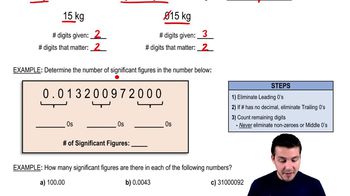
Counting Significant Figures

Trailing Zeros

Trailing zeros are the zeros that appear at the end of a number. Their significance depends on the presence of a decimal point. For example, in the number 8700, the trailing zeros are not considered significant unless specified by a decimal point (e.g., 8700. has four significant figures). This distinction is important for determining the correct number of significant figures.
Recommended video:
Guided course
07:03
Charges In A Line (Find Zero Force)

Measurement Precision

Measurement precision refers to the degree of reproducibility or consistency of a set of measurements. It is influenced by the measuring instrument and the method used. In the context of significant figures, precision is reflected in how many digits are reported, which indicates the certainty of the measurement and helps avoid misinterpretation of data.
Recommended video:
Guided course
07:49
Proper Frames and Measurements