 Back
BackPhysics Study Guide: Springs, Elasticity, Equilibrium, Impulse, Momentum, Energy, Collisions, Rotations
Study Guide - Smart Notes
 Tailored notes based on your materials, expanded with key definitions, examples, and context.
Q1. Two children push on opposite sides of a door. One pushes with 175 N at 0.700 m from the hinges, the other at 0.400 m. What force must the second exert to keep the door from moving? (Neglect friction.)
Background
Topic: Rotational Equilibrium and Torque
This question tests your understanding of how forces applied at different distances from a pivot (hinge) create torques, and how to balance them for equilibrium.
Key Terms and Formulas:
Torque ():
Rotational Equilibrium: (sum of torques must be zero for no rotation)
, ,
Step-by-Step Guidance
Write the condition for rotational equilibrium: (since the door doesn't move).
Express the torques: , .
Set up the equation: .
Rearrange to solve for : .
Try solving on your own before revealing the answer!
Final Answer:
(rounded to 3 significant figures: )
The second child must push with 306 N in the opposite direction to keep the door from moving.
Q2. An object of mass kg is attached to a spring ( N/m) and released from rest when the spring is stretched 4 m.
Background
Topic: Hooke's Law and Spring Forces
This question tests your understanding of the force exerted by a spring when stretched or compressed, and how it changes with displacement.
Key Terms and Formulas:
Hooke's Law:
= spring constant (N/m)
= displacement from equilibrium (m)
Step-by-Step Guidance
Identify the spring constant N/m and initial stretch m.
Apply Hooke's Law: .
Calculate the force: .
Interpret the sign: The negative sign means the force is directed toward the equilibrium position (opposite the stretch).
Try solving on your own before revealing the answer!
Final Answer: $160$ N toward equilibrium
The magnitude is 160 N, directed toward the anchor/equilibrium.
Q2b. What force is exerted when the spring is stretched only 2 m?
Background
Topic: Hooke's Law (continued)
This part asks you to apply the same principle for a different displacement.
Key Terms and Formulas:
m
Use
Step-by-Step Guidance
Plug in the new displacement: .
Again, the negative sign indicates direction toward equilibrium.
Try solving on your own before revealing the answer!
Final Answer: $80$ N toward equilibrium
The force is 80 N, directed toward the equilibrium position.
Q2c. At what point does the spring force vanish?
Background
Topic: Equilibrium Position of a Spring
This part tests your understanding of when a spring exerts no force.
Key Terms and Formulas:
Equilibrium position:
At ,
Step-by-Step Guidance
Recall that .
Set to find when .
Try solving on your own before revealing the answer!
Final Answer: At equilibrium (natural length)
The force vanishes when the spring is at its natural length ().
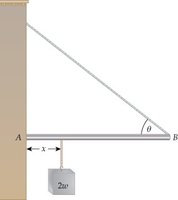
Q3. A uniform beam is supported by a cable at one end and friction at the other. The cable makes a 30° angle with the horizontal, the beam is 2.00 m long, the coefficient of static friction is , and the beam's weight is . What is the minimum distance from point A at which an additional weight can be hung without causing the rod to slip?
Background
Topic: Static Equilibrium, Torque, and Friction
This question tests your ability to analyze forces and torques on a beam, including the effects of friction and additional weights, to determine the conditions for equilibrium.
Key Terms and Formulas:
Torque ():
Static Friction:
Equilibrium Conditions: , ,
Beam length m, , weight , extra weight at distance from A
Step-by-Step Guidance
Draw a free-body diagram showing all forces: weight of beam ( at center), extra weight ( at distance ), tension in cable, normal force, and friction at point A.
Write the torque equilibrium equation about point A (sum of torques must be zero):
Write the force equilibrium equations in the horizontal and vertical directions.
Express the maximum static friction force: (where is the normal force at A).
Set up the condition for the beam to be on the verge of slipping: the horizontal component of the cable tension must equal .
Combine these equations to solve for the minimum where the extra weight can be hung without slipping.
Try solving on your own before revealing the answer!
Final Answer: m
By balancing torques and using the friction condition, you find the minimum is 0.560 m from point A.
