Ch 13: Newton's Theory of Gravity
Knight Calc - Physics for Scientists and Engineers 5th Edition
Knight Calc5th EditionPhysics for Scientists and EngineersISBN: 9780137344796Not the one you use?Change textbook
Chapter 13, Problem 38

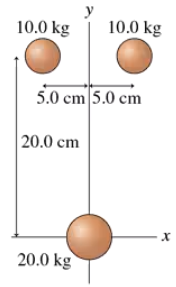
What is the total gravitational potential energy of the three masses in FIGURE P13.36?

Verified step by step guidance
1
Step 1: Understand the concept of gravitational potential energy. Gravitational potential energy between two masses is given by the formula: U=-Gmmr, where G is the gravitational constant, m and m are the masses, and r is the distance between them.
Step 2: Identify the three masses and their positions from the figure. Determine the distances between each pair of masses. Label the masses as m1, m2, and m3, and calculate the distances r12, r13, and r23.
Step 3: Calculate the gravitational potential energy for each pair of masses using the formula U=-Gmmr. For example, calculate U12, U13, and U23.
Step 4: Add the gravitational potential energies of all pairs to find the total gravitational potential energy. The total gravitational potential energy is given by: Utotal=U12+U13+U23.
Step 5: Ensure all values are substituted correctly, including the gravitational constant G, masses, and distances. Perform the addition to find the total gravitational potential energy.

Verified video answer for a similar problem:

This video solution was recommended by our tutors as helpful for the problem above.
Video duration:
9m
Was this helpful?

Key Concepts

Here are the essential concepts you must grasp in order to answer the question correctly.

Gravitational Potential Energy

Gravitational potential energy (U) is the energy an object possesses due to its position in a gravitational field. It is calculated using the formula U = mgh, where m is the mass, g is the acceleration due to gravity, and h is the height above a reference point. This energy is crucial for understanding how objects interact under the influence of gravity.
Recommended video:
Guided course
06:35
Gravitational Potential Energy

Mass and Weight

Mass is a measure of the amount of matter in an object, typically measured in kilograms. Weight, on the other hand, is the force exerted by gravity on that mass, calculated as W = mg. Understanding the distinction between mass and weight is essential for calculating gravitational potential energy, as the mass directly influences the energy value.
Recommended video:
Guided course
10:19
Torque Due to Weight

Reference Point in Potential Energy Calculations

In gravitational potential energy calculations, the choice of reference point is critical. The height (h) in the potential energy formula is measured relative to this reference point, which can be the ground, the lowest point of the system, or any other convenient level. Different reference points can yield different potential energy values, but the energy differences remain consistent.
Recommended video:
Guided course
04:06
Gravitational Potential Energy is "Relative"