Ch 12: Rotation of a Rigid Body
Knight Calc - Physics for Scientists and Engineers 5th Edition
Knight Calc5th EditionPhysics for Scientists and EngineersISBN: 9780137344796Not the one you use?Change textbook
Chapter 12, Problem 5

Two balls are connected by a 150-cm-long massless rod. The center of mass is 35 cm from a 75 g ball on one end. What is the mass attached to the other end?

Verified step by step guidance
1
Step 1: Understand the concept of the center of mass. The center of mass is the point where the weighted relative position of the masses is balanced. For a system of two masses connected by a rod, the center of mass can be calculated using the formula: xcm = (m1x1 + m2x2) / (m1 + m2), where xcm is the center of mass position, m1 and m2 are the masses, and x1 and x2 are their respective distances from a reference point.
Step 2: Assign the given values. The length of the rod is 150 cm, so the distance between the two masses is 150 cm. The center of mass is located 35 cm from the 75 g ball. Let the mass of the other ball be m2, and its distance from the center of mass will be 150 - 35 = 115 cm.
Step 3: Write the center of mass equation for this system. Using the reference point at the position of the 75 g ball, the equation becomes: 35 = (75 × 0 + m2 × 115) / (75 + m2). Here, the position of the 75 g ball is taken as 0 cm.
Step 4: Rearrange the equation to solve for m2. Multiply through by the denominator to eliminate the fraction: 35 × (75 + m2) = m2 × 115. Expand and simplify: 2625 + 35m2 = 115m2.
Step 5: Isolate m2 by moving terms involving m2 to one side: 2625 = 115m2 - 35m2. Simplify further: 2625 = 80m2. Finally, solve for m2 by dividing both sides by 80: m2 = 2625 / 80.

Verified video answer for a similar problem:

This video solution was recommended by our tutors as helpful for the problem above.
Video duration:
7m
Was this helpful?

Key Concepts

Here are the essential concepts you must grasp in order to answer the question correctly.

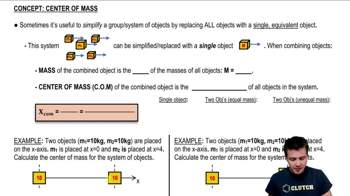
Center of Mass

The center of mass of a system is the point where the total mass of the system can be considered to be concentrated. It is calculated as the weighted average of the positions of all masses in the system, taking into account their respective masses. In this problem, the center of mass is used to determine the balance point between the two balls connected by the rod.
Recommended video:
Guided course
06:30
Intro to Center of Mass

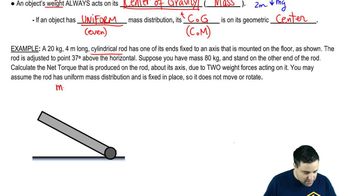
Mass and Weight

Mass is a measure of the amount of matter in an object, typically measured in grams or kilograms, while weight is the force exerted by gravity on that mass. In this scenario, the mass of the second ball needs to be calculated based on the position of the center of mass and the known mass of the first ball, illustrating the relationship between mass distribution and gravitational force.
Recommended video:
Guided course
10:19
Torque Due to Weight

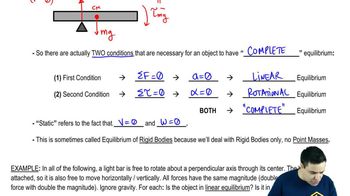
Equilibrium and Torque

In a system in equilibrium, the sum of torques around any point must be zero. This principle can be applied to the two balls connected by the rod, where the torque produced by the weight of each ball about the center of mass must balance out. Understanding this concept is essential for solving the problem, as it allows for the calculation of the unknown mass based on the known distances and mass.
Recommended video:
Guided course
10:13
Torque & Equilibrium