Ch 01: Concepts of Motion
Knight Calc - Physics for Scientists and Engineers 5th Edition
Knight Calc5th EditionPhysics for Scientists and EngineersISBN: 9780137344796Not the one you use?Change textbook
Chapter 1, Problem 58b

FIGURE P1.58 shows a motion diagram of a car traveling down a street. The camera took one frame every 10 s. A distance scale is provided. Make a position-versus-time graph for the car. Because you have data only at certain instants of time, your graph should consist of dots that are not connected together.

Verified step by step guidance
1
Examine the motion diagram provided in the problem. Identify the positions of the car at each time interval (every 10 seconds) using the distance scale provided in the diagram.
Create a table to organize the data. The table should have two columns: one for time (in seconds) and one for position (in meters). Record the position of the car at each 10-second interval based on the motion diagram.
Set up a coordinate system for the graph. Label the horizontal axis as 'Time (s)' and the vertical axis as 'Position (m)'. Choose an appropriate scale for both axes based on the range of time and position values from your table.
Plot the data points on the graph. For each time value from the table, place a dot at the corresponding position value. Ensure the dots are accurately placed according to the scales on the axes.
Do not connect the dots with lines, as the problem specifies that the graph should consist of unconnected dots. The resulting graph will represent the position of the car at discrete time intervals.

Verified video answer for a similar problem:

This video solution was recommended by our tutors as helpful for the problem above.
Video duration:
4m
Was this helpful?

Key Concepts

Here are the essential concepts you must grasp in order to answer the question correctly.

Position vs. Time Graph

A position-versus-time graph visually represents an object's position at various points in time. The x-axis typically denotes time, while the y-axis indicates position. Each point on the graph corresponds to the car's position at a specific time interval, allowing for the analysis of its motion. In this case, since data is collected at discrete intervals, the graph will consist of unconnected dots, illustrating the car's position at each 10-second mark.
Recommended video:
Guided course
03:04
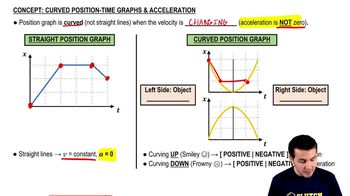
Curved Position-Time Graphs & Acceleration

Motion Diagrams

Motion diagrams are visual representations that depict an object's position at successive time intervals. They help in understanding the object's movement by showing its location at specific times, often using dots or arrows. In this scenario, the motion diagram of the car provides the necessary data points to plot the position-versus-time graph, highlighting how the car's position changes over time.
Recommended video:
Guided course
08:07
Work and PV Diagrams

Discrete Data

Discrete data refers to information that is collected at distinct intervals rather than continuously. In the context of the car's motion, the data points are recorded every 10 seconds, resulting in a series of individual positions rather than a smooth curve. This characteristic necessitates the use of unconnected points on the graph, emphasizing the specific times at which the car's position was measured.
Recommended video:
Guided course
05:19
Energy & Torque of Dipole Moments