
Ch 27: Current and Resistance
Knight Calc - Physics for Scientists and Engineers 5th Edition
Knight Calc5th EditionPhysics for Scientists and EngineersISBN: 9780137344796Not the one you use?Change textbook
Chapter 27, Problem 63b

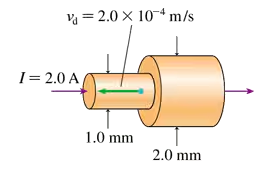
The two wires in FIGURE P27.63 are made of the same material. What is the electron drift speed in the 2.0-mm-diameter segment of the wire?
Illustration of a wire segment showing electron drift speed and current, with labeled dimensions and values.

Verified step by step guidance
1
Step 1: Understand the relationship between current, drift speed, and the cross-sectional area of the wire. The formula to calculate drift speed is: vd=IneA, where I is the current, n is the number density of electrons, e is the charge of an electron, and A is the cross-sectional area of the wire.
Step 2: Calculate the cross-sectional area of the wire segment using the formula for the area of a circle: A=πr2. The diameter of the wire is given as 2.0 mm, so the radius is half of the diameter: r=2.02=1.0 mm. Convert this to meters: r=1.0×10⁻³ m.
Step 3: Substitute the radius into the area formula to find the cross-sectional area: A=π×(1.0×10⁻³)2. This gives the area in square meters.
Step 4: Identify the values for the other variables in the drift speed formula. The current I should be provided or calculated from other parts of the problem. The number density of electrons n is a property of the material and can be looked up (e.g., for copper, n≈8.5×1028 electrons/m3). The charge of an electron e is a constant: e=1.6×10⁻¹⁹ C.
Step 5: Substitute all known values into the drift speed formula vd=IneA and simplify to find the drift speed. Ensure units are consistent throughout the calculation (e.g., meters, Coulombs, etc.).

Verified video answer for a similar problem:

This video solution was recommended by our tutors as helpful for the problem above.
Video duration:
6m
Was this helpful?

Key Concepts

Here are the essential concepts you must grasp in order to answer the question correctly.

Electron Drift Speed

Electron drift speed refers to the average velocity that free electrons in a conductor attain due to an electric field. It is typically very small, on the order of millimeters per second, and is influenced by factors such as the material's conductivity and the applied voltage. Understanding this concept is crucial for analyzing current flow in electrical circuits.
Recommended video:
Guided course
05:32
Speed of Electron in Electric Field

Current Density

Current density is defined as the electric current per unit area of cross-section in a conductor. It is expressed in amperes per square meter (A/m²) and is essential for calculating the drift speed of electrons. The relationship between current density, drift speed, and charge carrier density is given by the equation J = n*q*v_d, where J is current density, n is the number of charge carriers, q is the charge, and v_d is the drift speed.
Recommended video:
Guided course
8:13
Intro to Density

Ohm's Law

Ohm's Law states that the current flowing through a conductor between two points is directly proportional to the voltage across the two points and inversely proportional to the resistance of the conductor. This fundamental principle helps in understanding how voltage, current, and resistance interact in electrical circuits, which is essential for calculating parameters like drift speed in different segments of a wire.
Recommended video:
Guided course
03:07
Resistance and Ohm's Law
Related Practice
Textbook Question

You've decided to protect your house by placing a 5.0-m-tall iron lightning rod next to the house. The top is sharpened to a point and the bottom is in good contact with the ground. From your research, you've learned that lightning bolts can carry up to 50 kA of current and last up to 50 μs. How much charge is delivered by a lightning bolt with these parameters?

1
views
Textbook Question

An aluminum wire consists of the three segments shown in FIGURE P27.64. The current in the top segment is 10 A. For each of these three segments, find the current density J. Place your results in a table for easy viewing.

2
views
Textbook Question

The current supplied by a battery slowly decreases as the battery runs down. Suppose that the current as a function of time is I=(0.75A)et6hI=\(\left\)(0.75A\(\right\))e^{-\(\frac{t}{6h}\)}. What is the total number of electrons transported from the positive electrode to the negative electrode by the charge escalator from the time the battery is first used until it is completely dead?

2
views
Textbook Question

The total amount of charge that has entered a wire at time t is given by the expression Q=(20C)(1et2.0s)Q=\(\left\)(20C\(\right\))\(\left\)(1-e^{-\(\frac{t}{2.0s}\)}\(\right\)), where t is in seconds and t≥0. What is the maximum value of the current?

1
views
Textbook Question

What diameter should the nichrome wire in FIGURE P27.62 be in order for the electric field strength to be the same in both wires?

1
views
Textbook Question

An aluminum wire consists of the three segments shown in FIGURE P27.64. The current in the top segment is 10 A. For each of these three segments, find the drift velocity vd. Place your results in a table for easy viewing.

1
views