
Ch. 31 - Maxwell's Equations and Electromagnetic Waves
Giancoli Douglas - Physics for Scientists and Engineers 5th edition
Giancoli Douglas5th editionPhysics for Scientists and EngineersISBN: 9780137488179Not the one you use?Change textbook
Chapter 30, Problem 37

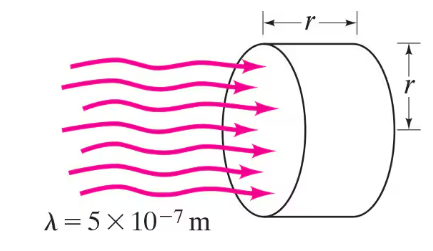
(II) Laser light can be focused (at best) to a spot with a radius r equal to its wavelength ⋋. Suppose a 1.0-W beam of green laser light (⋋ = 5 x 10⁻⁷ m) forms such a spot and illuminates a cylindrical object of radius r and length r (Fig. 31–25). Estimate (a) the radiation pressure and force on the object, and (b) its acceleration, if its density equals that of water and it absorbs all the radiation. [This order-of-magnitude calculation convinced researchers of the feasibility of “optical tweezers,” page 916.]

Verified step by step guidance
1
Step 1: Understand the problem and identify the key quantities. The laser light has a power of 1.0 W, a wavelength of 5 x 10⁻⁷ m, and forms a spot with radius r equal to its wavelength. The object is cylindrical with radius r and length r, and it absorbs all the radiation. The density of the object is equal to that of water (ρ = 1000 kg/m³). We need to estimate the radiation pressure, force, and acceleration.
Step 2: Calculate the intensity of the laser light. Intensity (I) is defined as power (P) divided by the area (A) over which the power is distributed. The area of the spot is the cross-sectional area of a circle: A = πr². Substitute r = ⋋ into the formula: I = P / (π⋋²).
Step 3: Determine the radiation pressure. Radiation pressure (P_r) is given by the formula P_r = I / c, where c is the speed of light in a vacuum (approximately 3 x 10⁸ m/s). Since the object absorbs all the radiation, this formula applies directly.
Step 4: Calculate the force exerted by the radiation pressure. Force (F) is related to pressure and area by the formula F = P_r * A. Use the area of the cylindrical object that is exposed to the laser light, which is the circular cross-sectional area: A = π⋋².
Step 5: Estimate the acceleration of the object. Acceleration (a) is given by Newton's second law: a = F / m, where m is the mass of the object. The mass can be calculated using the density (ρ) and the volume (V) of the cylinder: V = π⋋²⋋ (since the radius and length are both equal to ⋋). Substitute m = ρV into the formula for acceleration.

Verified video answer for a similar problem:

This video solution was recommended by our tutors as helpful for the problem above.
Video duration:
9m
Was this helpful?

Key Concepts

Here are the essential concepts you must grasp in order to answer the question correctly.

Radiation Pressure

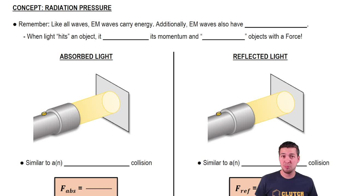
Radiation pressure is the pressure exerted by electromagnetic radiation on a surface. It arises from the momentum transfer of photons when they are absorbed or reflected by an object. The pressure can be calculated using the formula P = I/c, where P is the radiation pressure, I is the intensity of the light, and c is the speed of light. In this context, understanding radiation pressure is crucial for determining the force exerted on the cylindrical object by the laser light.
Recommended video:
Guided course
07:51
Radiation Pressure

Force Calculation

The force exerted on an object by radiation can be calculated using the formula F = P × A, where F is the force, P is the radiation pressure, and A is the area of the surface exposed to the light. In this scenario, the area can be determined based on the radius of the spot created by the laser. This concept is essential for estimating the total force acting on the cylindrical object due to the laser beam.
Recommended video:
Guided course
06:09
Work Done by a Constant Force

Acceleration and Density

Acceleration of an object can be determined using Newton's second law, F = m × a, where F is the net force, m is the mass, and a is the acceleration. The mass can be calculated from the object's volume and density, using the formula m = ρ × V, where ρ is the density and V is the volume. In this case, knowing the density of water allows for the calculation of the mass of the cylindrical object, which is necessary to find its acceleration when subjected to the force from the laser.
Recommended video:
Guided course
8:13
Intro to Density
Related Practice
Textbook Question

Suppose you have a car with a 100-hp engine. How large a solar panel would you need to replace the engine with solar power? Assume that the solar panels can utilize 20% of the maximum solar energy that reaches the Earth’s surface (1000 W/m²). Explain why or why not this is practical.

Textbook Question

In an EM wave traveling west, the B field oscillates up and down vertically and has a frequency of 85.0 kHz and an rms strength of 7.75 x 10⁻⁹ T. Determine the frequency and rms strength of the electric field. What is the direction of the electric field oscillations?

Textbook Question

Compare 1030 on the AM dial to 103.1 on FM. Which has the longer wavelength, and by what factor is it larger?

Textbook Question

(III) (a) When a circular parallel-plate capacitor is being charged as in Example 31–1, show that the Poynting vector S\(\overrightarrow{S}\) points radially inward toward the center of the capacitor, parallel to the plates.

1
views
Textbook Question

(a) When a circular parallel-plate capacitor is being charged as in Example 31–1, show that the Poynting vector S\(\overrightarrow{S}\) points radially inward toward the center of the capacitor, parallel to the plates.

(b) Integrate S\(\overrightarrow{S}\) over the cylindrical boundary of the capacitor gap to show that the rate at which energy enters the capacitor is equal to the rate at which electrostatic energy is being stored in the electric field of the capacitor (Section 24–4). Ignore fringing of E\(\overrightarrow{E}\).

Textbook Question

An amateur radio operator wishes to build a receiver that can tune a range from 14.0 MHz to 15.0 MHz. A variable capacitor has a minimum capacitance of 95 pF.

(a) What is the required value of the inductance?

(b) What is the maximum capacitance used on the variable capacitor?

2
views