
Ch. 31 - Maxwell's Equations and Electromagnetic Waves
Giancoli Douglas - Physics for Scientists and Engineers 5th edition
Giancoli Douglas5th editionPhysics for Scientists and EngineersISBN: 9780137488179Not the one you use?Change textbook
Chapter 30, Problem 47

An amateur radio operator wishes to build a receiver that can tune a range from 14.0 MHz to 15.0 MHz. A variable capacitor has a minimum capacitance of 95 pF.
(a) What is the required value of the inductance?
(b) What is the maximum capacitance used on the variable capacitor?

Verified step by step guidance
1
Step 1: Understand the problem. The receiver uses an LC circuit (inductor-capacitor circuit) to tune frequencies. The resonant frequency of an LC circuit is given by the formula: f = rac{1}{2 extpi extsqrt{LC}}, where f is the frequency, L is the inductance, and C is the capacitance.
Step 2: Rearrange the formula to solve for inductance L. Using the minimum capacitance C = 95 \(\text{ pF}\) and the maximum frequency f = 15.0 \(\text{ MHz}\), substitute these values into the formula: L = rac{1}{(2 extpi extsqrt{f^2C})}. Ensure units are consistent (convert MHz to Hz and pF to F).
Step 3: To find the maximum capacitance, use the same formula for resonant frequency but substitute the minimum frequency f = 14.0 \(\text{ MHz}\) and the calculated inductance L. Rearrange the formula to solve for C: C = rac{1}{(4 extpi^2f^2L)}. Substitute the values and ensure unit consistency.
Step 4: Perform dimensional analysis to ensure all units are consistent. Convert MHz to Hz (1 \(\text{ MHz}\) = 10^6 \(\text{ Hz}\)) and pF to F (1 \(\text{ pF}\) = 10^{-12} \(\text{ F}\)). This ensures the calculations are accurate.
Step 5: After substituting the values and performing the calculations, you will have the required inductance for part (a) and the maximum capacitance for part (b). These values will allow the LC circuit to tune the desired frequency range.

Verified video answer for a similar problem:

This video solution was recommended by our tutors as helpful for the problem above.
Video duration:
1m
Was this helpful?

Key Concepts

Here are the essential concepts you must grasp in order to answer the question correctly.

Resonant Frequency

The resonant frequency is the frequency at which a circuit naturally oscillates when not subjected to a continuous external force. In an LC circuit, this frequency is determined by the inductance (L) and capacitance (C) values, following the formula f = 1/(2π√(LC)). Understanding this concept is crucial for determining the appropriate inductance needed to tune the radio receiver to the desired frequency range.
Recommended video:
Guided course
05:23
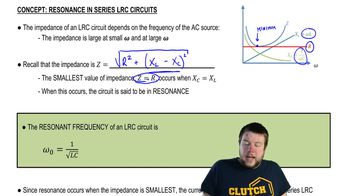
Resonance in Series LRC Circuits

Inductance

Inductance is a property of an electrical component, typically a coil or inductor, that quantifies its ability to store energy in a magnetic field when an electric current flows through it. The value of inductance is essential for tuning circuits, as it directly affects the resonant frequency. In this context, calculating the required inductance allows the radio operator to achieve the desired frequency range for the receiver.
Recommended video:
Guided course
12:59
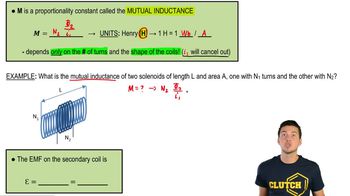
Mutual Induction

Capacitance

Capacitance is the ability of a component, usually a capacitor, to store electrical energy in an electric field. It is measured in farads and is critical in tuning circuits, as varying the capacitance alters the resonant frequency. In this scenario, knowing the minimum capacitance and calculating the maximum capacitance helps the operator design a variable capacitor that can effectively tune the receiver across the specified frequency range.
Recommended video:
Guided course
08:02
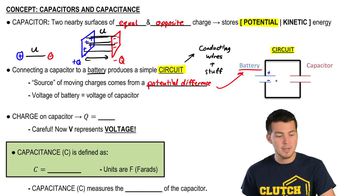
Capacitors & Capacitance (Intro)
Related Practice
Textbook Question

Suppose you have a car with a 100-hp engine. How large a solar panel would you need to replace the engine with solar power? Assume that the solar panels can utilize 20% of the maximum solar energy that reaches the Earth’s surface (1000 W/m²). Explain why or why not this is practical.

Textbook Question

A global positioning system (GPS) functions by determining the travel times for EM waves from various satellites to a moving GPS receiver on Earth (car or hiker). If the receiver is to detect a change in the receiver’s position on the order of 3 m, what is the associated change in travel time (in ns) that must be measured?

Textbook Question

Compare 1030 on the AM dial to 103.1 on FM. Which has the longer wavelength, and by what factor is it larger?

Textbook Question

Who will hear the voice of a singer first: a person in the balcony 50.0 km away from the stage (see Fig. 31–26), or a person 1800 km away at home whose ear is next to the radio listening to a live broadcast? Roughly how much sooner? Assume the microphone is a few centimeters from the singer and the temperature is 20℃.


<IMAGE>

1
views
Textbook Question

A satellite beams microwave radiation with a power of 16 kW toward the Earth’s surface, 550 km away. When the beam strikes Earth, its circular diameter is about 1500 m. Find the rms electric field strength of the beam.

Textbook Question

(II) Laser light can be focused (at best) to a spot with a radius r equal to its wavelength ⋋. Suppose a 1.0-W beam of green laser light (⋋ = 5 x 10⁻⁷ m) forms such a spot and illuminates a cylindrical object of radius r and length r (Fig. 31–25). Estimate (a) the radiation pressure and force on the object, and (b) its acceleration, if its density equals that of water and it absorbs all the radiation. [This order-of-magnitude calculation convinced researchers of the feasibility of “optical tweezers,” page 916.]

1
views