Ch 29: The Magnetic Field
Knight Calc - Physics for Scientists and Engineers 5th Edition
Knight Calc5th EditionPhysics for Scientists and EngineersISBN: 9780137344796Not the one you use?Change textbook
Chapter 29, Problem 3

A proton moves along the x-axis with vₓ = 1.0 x 10⁷ m/s. As it passes the origin, what are the strength and direction of the magnetic field at the (x, y, z) positions (a) (1 cm, 0 cm, 0 cm), (b) (0 cm, 1 cm, 0 cm), and (c) (0 cm, -2 cm, 0 cm)?

Verified step by step guidance
1
Step 1: Recall the formula for the magnetic field produced by a moving charge. The magnetic field at a point due to a moving charge is given by **B = (μ₀ / 4π) * (q * v × r̂) / r²**, where μ₀ is the permeability of free space, q is the charge, v is the velocity vector, r̂ is the unit vector pointing from the charge to the observation point, and r is the distance between the charge and the observation point.
Step 2: Identify the given values. The charge of a proton is q = 1.6 × 10⁻¹⁹ C, the velocity vector is **v = (1.0 × 10⁷ m/s) î**, and the observation points are (a) (1 cm, 0 cm, 0 cm), (b) (0 cm, 1 cm, 0 cm), and (c) (0 cm, -2 cm, 0 cm). Convert the distances to meters: 1 cm = 0.01 m, 2 cm = 0.02 m.
Step 3: For each observation point, calculate the distance vector **r** and the unit vector **r̂**. For example, for point (a), **r = (0.01 m) î**, and **r̂ = r / |r| = î**. Similarly, calculate **r** and **r̂** for points (b) and (c).
Step 4: Compute the cross product **v × r̂** for each observation point. For point (a), since **v** and **r̂** are parallel, the cross product is zero, meaning the magnetic field at (1 cm, 0 cm, 0 cm) is zero. For points (b) and (c), use the right-hand rule to determine the direction of **v × r̂** and calculate its magnitude.
Step 5: Substitute the values into the formula for **B** to find the magnitude and direction of the magnetic field at each point. Use the calculated **v × r̂**, the distance **r**, and the constants μ₀ = 4π × 10⁻⁷ T·m/A and q = 1.6 × 10⁻¹⁹ C to determine the magnetic field strength at points (b) and (c).

Verified video answer for a similar problem:

This video solution was recommended by our tutors as helpful for the problem above.
Video duration:
6m
Was this helpful?

Key Concepts

Here are the essential concepts you must grasp in order to answer the question correctly.

Magnetic Field Due to a Moving Charge

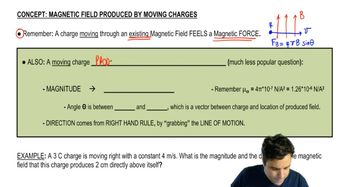
A moving charge, such as a proton, generates a magnetic field around it. The strength and direction of this magnetic field can be determined using the right-hand rule and the Biot-Savart law, which relates the magnetic field to the velocity of the charge and its distance from the point of interest.
Recommended video:
Guided course
10:47
Magnetic Field Produced by Moving Charges

Right-Hand Rule

The right-hand rule is a mnemonic used to determine the direction of the magnetic field produced by a moving charge. By pointing the thumb of the right hand in the direction of the charge's velocity and curling the fingers, the direction of the magnetic field lines can be found, which are perpendicular to both the velocity and the direction of the magnetic field.
Recommended video:
Guided course
19:11
Force on Moving Charges & Right Hand Rule

Coordinate System and Position Vectors

In physics, a coordinate system is used to define the position of points in space. The positions given in the question (e.g., (1 cm, 0 cm, 0 cm)) represent points in a three-dimensional Cartesian coordinate system, where the x, y, and z coordinates indicate the location in space relative to the origin. Understanding this system is crucial for calculating the magnetic field at specific points.
Recommended video:
Guided course
07:07
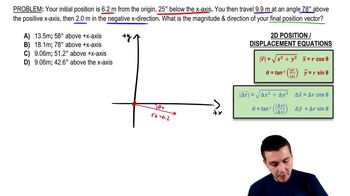
Final Position Vector