Ch 11: Impulse and Momentum
Knight Calc - Physics for Scientists and Engineers 5th Edition
Knight Calc5th EditionPhysics for Scientists and EngineersISBN: 9780137344796Not the one you use?Change textbook
Chapter 11, Problem 65

One end of a massless, 30-cm-long spring with spring constant 15 N/m is attached to a 250 g stationary air-track glider; the other end is attached to the track. A 500 g glider hits and sticks to the 250 g glider, compressing the spring to a minimum length of 22 cm. What was the speed of the 500 g glider just before impact?

Verified step by step guidance
1
Step 1: Identify the conservation principle applicable to the problem. Since the collision is inelastic (the two gliders stick together), the principle of conservation of momentum applies to determine the velocity of the combined gliders immediately after the collision.
Step 2: Write the equation for conservation of momentum. Let the mass of the 500 g glider be \( m_1 = 0.500 \, \text{kg} \), the mass of the 250 g glider be \( m_2 = 0.250 \; \text{kg} \), and the initial velocity of the 250 g glider be \( v_2 = 0 \; \text{m/s} \). The equation is: \( m_1 v_1 + m_2 v_2 = (m_1 + m_2) v_f \), where \( v_f \) is the velocity of the combined gliders after the collision.
Step 3: Relate the spring compression to the kinetic energy of the combined gliders. After the collision, the kinetic energy of the combined gliders is converted into potential energy stored in the spring. Use the formula for elastic potential energy: \( U = \frac{1}{2} k x^2 \), where \( k = 15 \; \text{N/m} \) is the spring constant and \( x \) is the compression of the spring (\( x = 30 \; \text{cm} - 22 \; \text{cm} = 8 \; \text{cm} = 0.08 \; \text{m} \)).
Step 4: Write the equation for energy conservation. The kinetic energy of the combined gliders immediately after the collision is equal to the potential energy stored in the spring at maximum compression: \( \frac{1}{2} (m_1 + m_2) v_f^2 = \frac{1}{2} k x^2 \). Solve for \( v_f \) using this equation.
Step 5: Combine the results from Steps 2 and 4. Substitute \( v_f \) from Step 4 into the momentum conservation equation from Step 2 to solve for \( v_1 \), the initial velocity of the 500 g glider before the collision.

Verified video answer for a similar problem:

This video solution was recommended by our tutors as helpful for the problem above.
Video duration:
11m
Was this helpful?

Key Concepts

Here are the essential concepts you must grasp in order to answer the question correctly.

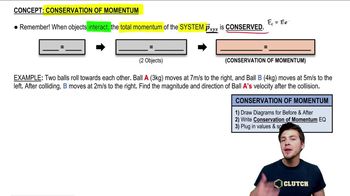
Conservation of Momentum

The principle of conservation of momentum states that in a closed system, the total momentum before an event must equal the total momentum after the event. In this scenario, the collision between the two gliders is an inelastic collision, where they stick together. Thus, the momentum of the 500 g glider before impact must equal the combined momentum of both gliders after the collision.
Recommended video:
Guided course
05:58
Conservation Of Momentum

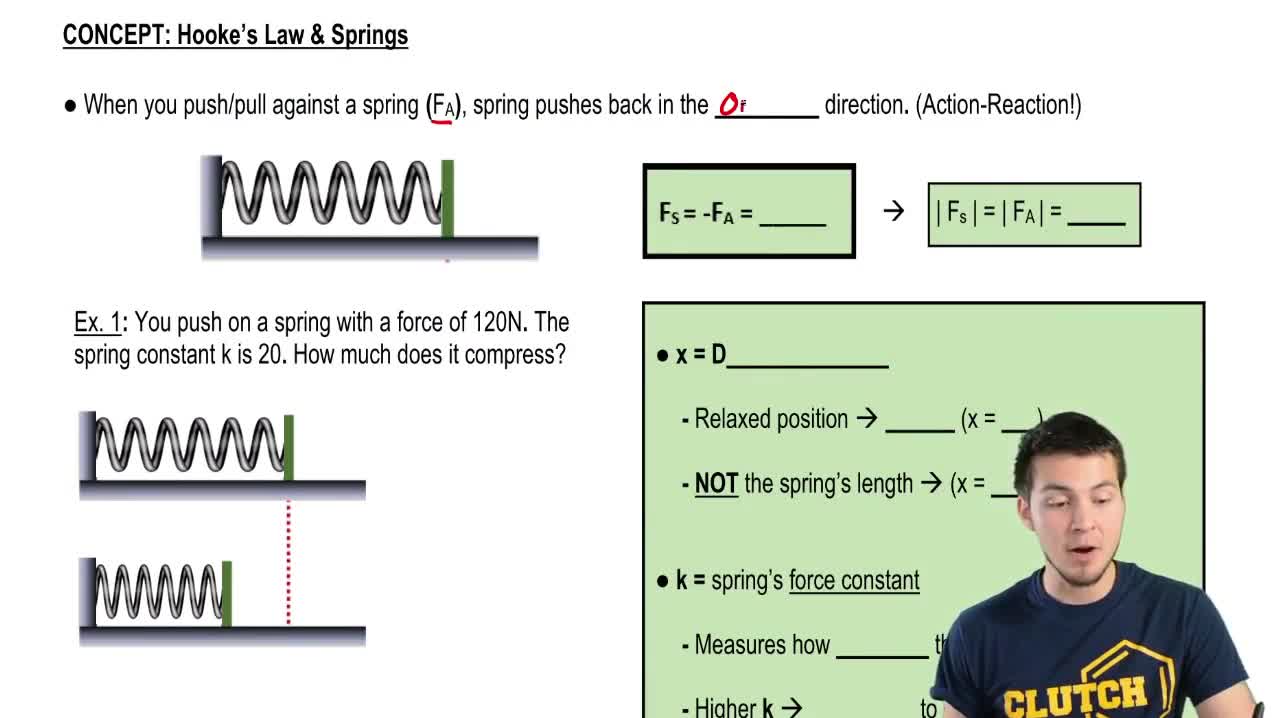
Hooke's Law

Hooke's Law describes the behavior of springs, stating that the force exerted by a spring is directly proportional to its displacement from the equilibrium position, expressed as F = -kx, where k is the spring constant and x is the displacement. In this problem, the spring compresses when the gliders collide, and the force exerted by the spring can be used to determine the energy transferred during the collision.
Recommended video:
Guided course
05:27
Spring Force (Hooke's Law)

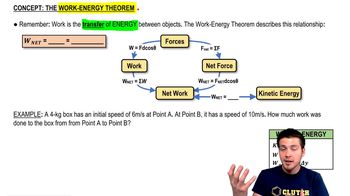
Kinetic Energy and Work-Energy Principle

The work-energy principle states that the work done on an object is equal to the change in its kinetic energy. In this case, the kinetic energy of the 500 g glider before impact is converted into potential energy stored in the spring when it is compressed. By calculating the potential energy at maximum compression, we can find the initial speed of the 500 g glider just before the collision.
Recommended video:
Guided course
04:10
The Work-Energy Theorem
Related Practice
Textbook Question

A 100 g ball moving to the right at 4.0 m/s collides head-on with a 200g ball that is moving to the left at 3.0 m/s. If the collision is perfectly elastic, what are the speed and direction of each ball after the collision?

1
views

Textbook Question

A 500 g particle has velocity vx = −5.0 m/s at t = −2 s. Force Fx = (4−t2) N, where t is in s, is exerted on the particle between t = −2 s and t = 2 s. This force increases from 0 N at t = −2 s to 4 N at t = 0 s and then back to 0 N at t = 2 s. What is the particle's velocity at t = 2s?

1
views
Textbook Question

A 30 ton rail car and a 90 ton rail car, initially at rest, are connected together with a giant but massless compressed spring between them. When released, the 30 ton car is pushed away at a speed of 4.0 m/s relative to the 90 ton car. What is the speed of the 30 ton car relative to the ground?

1
views
Textbook Question

Consider a partially elastic collision in which ball A of mass m with initial velocity (vix)A collides with stationary ball B, also of mass m, and in which 1/4 of the mechanical energy is dissipated as thermal energy. Find expressions for the final velocities of each ball. Hint: Mathematically there are two solutions; however, one of them is physically impossible.

1
views
Textbook Question

The nucleus of the polonium isotope ²¹⁴Po (mass 214 u) is radioactive and decays by emitting an alpha particle (a helium nucleus with mass 4 u). Laboratory experiments measure the speed of the alpha particle to be 1.92×10⁷ m/s . Assuming the polonium nucleus was initially at rest, what is the recoil speed of the nucleus that remains after the decay?

2
views
Textbook Question

A neutron is an electrically neutral subatomic particle with a mass just slightly greater than that of a proton. A free neutron is radioactive and decays after a few minutes into other subatomic particles. In one experiment, a neutron at rest was observed to decay into a proton (mass 1.67×10⁻²⁷ kg) and an electron (mass 9.11×10⁻³¹ kg) . The proton and electron were shot out back-to-back. The proton speed was measured to be 1.0 ×10⁵ m/s, and the electron speed was 3.0×10⁷ m/s. No other decay products were detected. How much momentum did this neutrino 'carry away' with it?

3
views