Ch 11: Impulse and Momentum
Knight Calc - Physics for Scientists and Engineers 5th Edition
Knight Calc5th EditionPhysics for Scientists and EngineersISBN: 9780137344796Not the one you use?Change textbook
Chapter 11, Problem 68

The nucleus of the polonium isotope ²¹⁴Po (mass 214 u) is radioactive and decays by emitting an alpha particle (a helium nucleus with mass 4 u). Laboratory experiments measure the speed of the alpha particle to be 1.92×10⁷ m/s . Assuming the polonium nucleus was initially at rest, what is the recoil speed of the nucleus that remains after the decay?

Verified step by step guidance
1
Step 1: Identify the principle of conservation of momentum. Since the polonium nucleus is initially at rest, the total momentum before decay is zero. After the decay, the momentum of the alpha particle and the recoil momentum of the remaining nucleus must sum to zero.
Step 2: Write the equation for conservation of momentum. Let the mass of the alpha particle be \( m_{\alpha} = 4 \, \text{u} \), the mass of the remaining nucleus be \( m_{\text{recoil}} = 214 - 4 = 210 \, \text{u} \), the speed of the alpha particle be \( v_{\alpha} = 1.92 \times 10^7 \, \text{m/s} \), and the recoil speed of the remaining nucleus be \( v_{\text{recoil}} \). The momentum conservation equation is: \( m_{\alpha} v_{\alpha} + m_{\text{recoil}} v_{\text{recoil}} = 0 \).
Step 3: Rearrange the equation to solve for the recoil speed \( v_{\text{recoil}} \). From the conservation of momentum equation, \( v_{\text{recoil}} = - \frac{m_{\alpha} v_{\alpha}}{m_{\text{recoil}}} \). The negative sign indicates that the recoil direction is opposite to the direction of the alpha particle.
Step 4: Convert the masses from atomic mass units (u) to kilograms if needed. The conversion factor is \( 1 \, \text{u} = 1.66 \times 10^{-27} \, \text{kg} \). However, since the ratio of masses is dimensionless, you can directly use the values in atomic mass units for this calculation.
Step 5: Substitute the given values into the formula \( v_{\text{recoil}} = - \frac{m_{\alpha} v_{\alpha}}{m_{\text{recoil}}} \). Use \( m_{\alpha} = 4 \), \( m_{\text{recoil}} = 210 \), and \( v_{\alpha} = 1.92 \times 10^7 \, \text{m/s} \) to calculate the recoil speed. Ensure the units are consistent throughout the calculation.

Verified video answer for a similar problem:

This video solution was recommended by our tutors as helpful for the problem above.
Video duration:
4m
Was this helpful?

Key Concepts

Here are the essential concepts you must grasp in order to answer the question correctly.

Conservation of Momentum

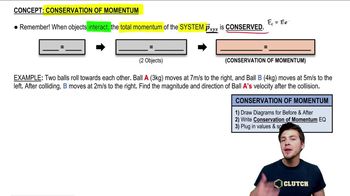
The principle of conservation of momentum states that in a closed system, the total momentum before an event must equal the total momentum after the event. In this case, the initial momentum of the polonium nucleus is zero since it is at rest. After the decay, the momentum of the emitted alpha particle and the recoiling polonium nucleus must balance each other, allowing us to calculate the recoil speed.
Recommended video:
Guided course
05:58
Conservation Of Momentum

Alpha Decay

Alpha decay is a type of radioactive decay in which an unstable nucleus emits an alpha particle, which consists of two protons and two neutrons (essentially a helium nucleus). This process reduces the mass and atomic number of the original nucleus, resulting in a new element. Understanding alpha decay is crucial for analyzing the changes in mass and momentum during the decay of polonium-214.
Recommended video:
Guided course
04:24
Amplitude Decay in an LRC Circuit

Kinetic Energy

Kinetic energy is the energy possessed by an object due to its motion, calculated using the formula KE = 1/2 mv², where m is mass and v is velocity. In this scenario, the kinetic energy of the emitted alpha particle can be related to the recoil speed of the remaining nucleus. While the question primarily focuses on momentum, recognizing the kinetic energy involved helps in understanding the dynamics of the decay process.
Recommended video:
Guided course
06:07
Intro to Rotational Kinetic Energy
Related Practice
Textbook Question

A 100 g ball moving to the right at 4.0 m/s collides head-on with a 200g ball that is moving to the left at 3.0 m/s. If the collision is perfectly elastic, what are the speed and direction of each ball after the collision?

1
views

Textbook Question

Consider a partially elastic collision in which ball A of mass m with initial velocity (vix)A collides with stationary ball B, also of mass m, and in which 1/4 of the mechanical energy is dissipated as thermal energy. Find expressions for the final velocities of each ball. Hint: Mathematically there are two solutions; however, one of them is physically impossible.

1
views
Textbook Question

A 45 g projectile explodes into three pieces: a 20 g piece with velocity 25 î m/s, a 15 g piece with velocity −10 î + 10ĵ m/s, and a 10 g piece with velocity −15 î − 20ĵ m/s. What was the projectile's velocity just before the explosion?

1
views
Textbook Question

A white ball traveling at 2.0m/s hits an equal-mass red ball at rest. The white ball is deflected by 25° and slowed to 1.5m/s. What percentage of the initial mechanical energy is lost in the collision?

1
views
Textbook Question

One end of a massless, 30-cm-long spring with spring constant 15 N/m is attached to a 250 g stationary air-track glider; the other end is attached to the track. A 500 g glider hits and sticks to the 250 g glider, compressing the spring to a minimum length of 22 cm. What was the speed of the 500 g glider just before impact?

2
views
Textbook Question

A neutron is an electrically neutral subatomic particle with a mass just slightly greater than that of a proton. A free neutron is radioactive and decays after a few minutes into other subatomic particles. In one experiment, a neutron at rest was observed to decay into a proton (mass 1.67×10⁻²⁷ kg) and an electron (mass 9.11×10⁻³¹ kg) . The proton and electron were shot out back-to-back. The proton speed was measured to be 1.0 ×10⁵ m/s, and the electron speed was 3.0×10⁷ m/s. No other decay products were detected. How much momentum did this neutrino 'carry away' with it?

3
views