Ch 05: Applying Newton's Laws
Young & Freedman Calc - University Physics 14th Edition
Young & Freedman Calc14th EditionUniversity PhysicsISBN: 9780321973610Not the one you use?Change textbook
Chapter 5, Problem 8b

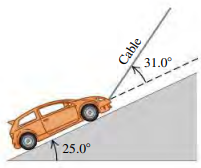
A 11301130-kg car is held in place by a light cable on a very smooth (frictionless) ramp (Fig. E5.85.8). The cable makes an angle of 31.0°31.0° above the surface of the ramp, and the ramp itself rises at 25.0°25.0° above the horizontal. Find the tension in the cable.
An orange car on a frictionless ramp, held by a cable at a 31° angle, ramp inclined at 25°.

Verified step by step guidance
1
Step 1: Identify the forces acting on the car. The forces include the gravitational force (weight of the car), the tension in the cable, and the normal force exerted by the ramp. The weight of the car can be calculated using the formula: Fg=mg, where m is the mass of the car and g is the acceleration due to gravity.
Step 2: Break the forces into components along the ramp and perpendicular to the ramp. The weight of the car has a component parallel to the ramp given by Fg=mgθ, where θ is the angle of the ramp (25.0°). The perpendicular component is F=mgθ.
Step 3: Analyze the tension in the cable. The cable makes an angle of 31.0° above the ramp. The tension force has two components: one parallel to the ramp and one perpendicular to the ramp. The parallel component is T=T31.0°, and the perpendicular component is T=T31.0°.
Step 4: Apply Newton's second law along the ramp. Since the car is stationary, the net force along the ramp is zero. This means the tension's parallel component balances the weight's parallel component: T=Fg. Substitute the expressions for these components to solve for the tension.
Step 5: Solve for the tension in the cable. Rearrange the equation to isolate T: T=Fg31.0°. Substitute the values for m, g, and the angles to find the tension.

Verified video answer for a similar problem:

This video solution was recommended by our tutors as helpful for the problem above.
Video duration:
6m
Was this helpful?

Key Concepts

Here are the essential concepts you must grasp in order to answer the question correctly.

Forces on an Inclined Plane

When an object is on an inclined plane, the forces acting on it include gravitational force, normal force, and any tension or frictional forces. The gravitational force can be resolved into two components: one parallel to the incline, which causes the object to slide down, and one perpendicular to the incline, which is balanced by the normal force. Understanding these forces is crucial for analyzing the motion and equilibrium of the object.
Recommended video:
Guided course
06:59
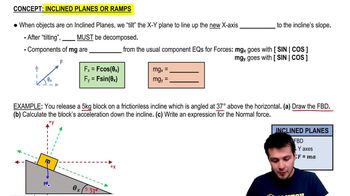
Intro to Inclined Planes

Tension in a Cable

Tension is the force transmitted through a cable or rope when it is pulled tight by forces acting from opposite ends. In this scenario, the tension in the cable must counteract the component of the gravitational force acting down the ramp, as well as any other forces acting on the car. Calculating the tension involves using trigonometric relationships based on the angles given in the problem.
Recommended video:
Guided course
03:25
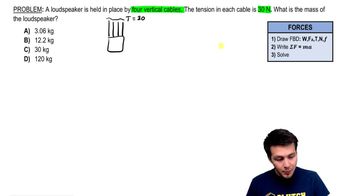
Multiple Cables on a Loudspeaker

Trigonometric Functions

Trigonometric functions, such as sine, cosine, and tangent, relate the angles of a triangle to the ratios of its sides. In physics problems involving angles, these functions are essential for resolving forces into their components. For example, the sine function can be used to find the component of the gravitational force acting parallel to the incline, while the cosine function can help determine the normal force acting perpendicular to the incline.
Recommended video:
Guided course
08:30
Intro to Wave Functions
Related Practice
Textbook Question

A man pushes on a piano with mass 180180 kg; it slides at constant velocity down a ramp that is inclined at 19.0°19.0° above the horizontal floor. Neglect any friction acting on the piano. Calculate the magnitude of the force applied by the man if he pushes parallel to the incline.

3
views
Textbook Question

A man pushes on a piano with mass 180180 kg; it slides at constant velocity down a ramp that is inclined at 19.0°19.0° above the horizontal floor. Neglect any friction acting on the piano. Calculate the magnitude of the force applied by the man if he pushes parallel to the floor.

5
views
Textbook Question

Find the tension in each cord in Fig. E5.75.7 if the weight of the suspended object is ww.

3
views
Textbook Question

A large wrecking ball is held in place by two light steel cables (Fig. E5.65.6). If the mass m of the wrecking ball is 36203620 kg, what are the (a) tension TBT_B in the cable that makes an angle of 40°40° with the vertical and (b) the tension TAT_{A} in the horizontal cable?

2
views
Textbook Question

A 11301130-kg car is held in place by a light cable on a very smooth (frictionless) ramp (Fig. E5.85.8). The cable makes an angle of 31.0°31.0° above the surface of the ramp, and the ramp itself rises at 25.0°25.0° above the horizontal. How hard does the surface of the ramp push on the car?

1
views
Textbook Question

A 11301130-kg car is held in place by a light cable on a very smooth (frictionless) ramp (Fig. E5.85.8). The cable makes an angle of 31.0°31.0° above the surface of the ramp, and the ramp itself rises at 25.0°25.0° above the horizontal. Draw a free-body diagram for the car.

3
views