Ch 05: Applying Newton's Laws
Young & Freedman Calc - University Physics 14th Edition
Young & Freedman Calc14th EditionUniversity PhysicsISBN: 9780321973610Not the one you use?Change textbook
Chapter 5, Problem 6

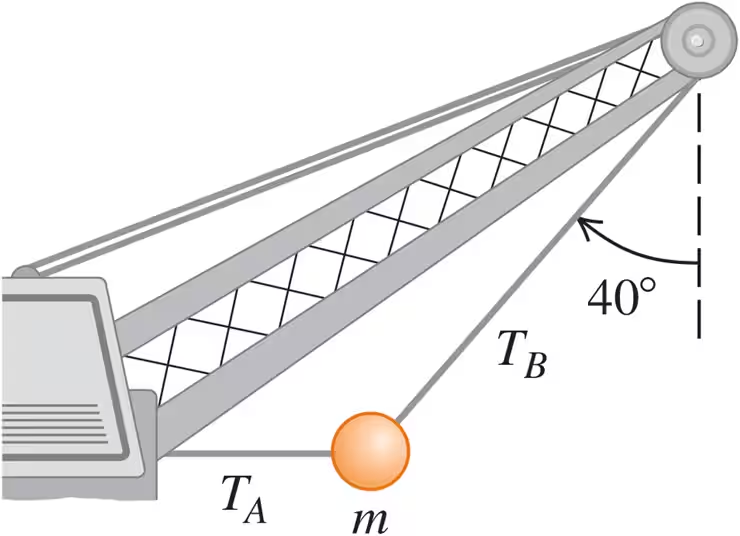
A large wrecking ball is held in place by two light steel cables (Fig. E5.65.6). If the mass m of the wrecking ball is 36203620 kg, what are the (a) tension TBT_B in the cable that makes an angle of 40°40° with the vertical and (b) the tension TAT_{A} in the horizontal cable?
A diagram showing a wrecking ball suspended by two cables, with angles and tensions labeled for analysis.

Verified step by step guidance
1
Step 1: Begin by analyzing the forces acting on the wrecking ball. The ball is in equilibrium, meaning the net force in both the horizontal and vertical directions is zero. The forces include the weight of the ball (mg), the tension in the horizontal cable (TA), and the tension in the angled cable (TB).
Step 2: Write the equilibrium condition for the vertical direction. The vertical component of TB must balance the weight of the ball. Use the equation: TB * cos(40°) = mg, where m = 3620 kg and g = 9.8 m/s².
Step 3: Write the equilibrium condition for the horizontal direction. The horizontal component of TB must balance the tension in the horizontal cable TA. Use the equation: TA = TB * sin(40°).
Step 4: Solve the first equation for TB. Substitute the values of m and g into TB * cos(40°) = mg to find TB.
Step 5: Use the value of TB obtained from Step 4 in the second equation TA = TB * sin(40°) to find TA.

Verified video answer for a similar problem:

This video solution was recommended by our tutors as helpful for the problem above.
Video duration:
8m
Was this helpful?

Key Concepts

Here are the essential concepts you must grasp in order to answer the question correctly.

Tension in Cables

Tension is the force exerted along a cable or rope when it is pulled tight by forces acting from opposite ends. In this scenario, the tensions in the cables must balance the weight of the wrecking ball, which is determined by its mass and the acceleration due to gravity. Understanding how to resolve these tensions into their vertical and horizontal components is crucial for solving the problem.
Recommended video:
Guided course
03:25
Multiple Cables on a Loudspeaker

Equilibrium of Forces

An object is in equilibrium when the net force acting on it is zero. For the wrecking ball, this means that the sum of the vertical forces (the weight of the ball and the vertical components of the tensions) must equal zero, and the sum of the horizontal forces (the horizontal components of the tensions) must also equal zero. This principle allows us to set up equations to solve for the unknown tensions.
Recommended video:

Trigonometric Functions

Trigonometric functions, such as sine and cosine, are essential for resolving the tensions in the cables into their components. Given the angles of the cables with respect to the vertical, these functions help calculate the vertical and horizontal components of the tension forces. This is necessary for applying the equilibrium conditions to find the tensions in the cables.
Recommended video:
Guided course
08:30
Intro to Wave Functions