

Ch. 30 - Inductance, Electromagnetic Oscillations, and AC Circuits
Giancoli Douglas - Physics for Scientists and Engineers 5th edition
Giancoli Douglas5th editionPhysics for Scientists and EngineersISBN: 9780137488179Not the one you use?Change textbook
Chapter 29, Problem 14

The magnetic field inside an air-filled solenoid 38.0 cm long and 2.10 cm in diameter is 0.720 T. Approximately how much energy is stored in this field?

Verified step by step guidance
1
Determine the volume of the solenoid. The volume can be calculated using the formula for the volume of a cylinder: \( V = \pi r^2 L \), where \( r \) is the radius of the solenoid (half the diameter) and \( L \) is its length. Convert the diameter and length to meters before substituting into the formula.
Calculate the energy density of the magnetic field using the formula: \( u = \frac{B^2}{2 \mu_0} \), where \( B \) is the magnetic field strength and \( \mu_0 \) is the permeability of free space (\( \mu_0 = 4\pi \times 10^{-7} \ \text{T·m/A} \)).
Multiply the energy density \( u \) by the volume \( V \) of the solenoid to find the total energy stored in the magnetic field. Use the formula: \( U = u \cdot V \).
Ensure all units are consistent (e.g., meters for length, Tesla for magnetic field strength) before performing the calculations.
Combine the results from the previous steps to express the total energy stored in the magnetic field in joules (J).

Verified video answer for a similar problem:

This video solution was recommended by our tutors as helpful for the problem above.
Video duration:
6m
Was this helpful?

Key Concepts

Here are the essential concepts you must grasp in order to answer the question correctly.

Magnetic Field in a Solenoid

A solenoid is a coil of wire that generates a magnetic field when an electric current passes through it. The strength of the magnetic field inside a long solenoid is uniform and can be calculated using the formula B = μ₀(nI), where B is the magnetic field strength, μ₀ is the permeability of free space, n is the number of turns per unit length, and I is the current. In this case, the magnetic field strength is given as 0.720 T.
Recommended video:
Guided course
13:54
Magnetic Field Produced by Loops and Solenoids

Energy Density of a Magnetic Field

The energy stored in a magnetic field can be expressed as energy density, which is the energy per unit volume. The formula for the energy density (u) in a magnetic field is u = (1/2μ₀)B², where B is the magnetic field strength. This concept is crucial for calculating the total energy stored in the magnetic field of the solenoid.
Recommended video:
Guided course
05:30
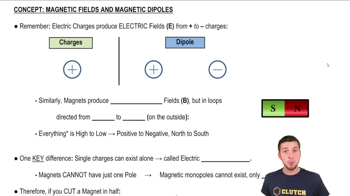
Magnetic Fields and Magnetic Dipoles

Volume of the Solenoid

To find the total energy stored in the magnetic field, we need to calculate the volume of the solenoid. The volume (V) can be determined using the formula V = A * L, where A is the cross-sectional area and L is the length of the solenoid. For a cylindrical solenoid, the area A can be calculated using A = π(r²), where r is the radius. This volume is essential for multiplying by the energy density to find the total energy.
Recommended video:
Guided course
11:47
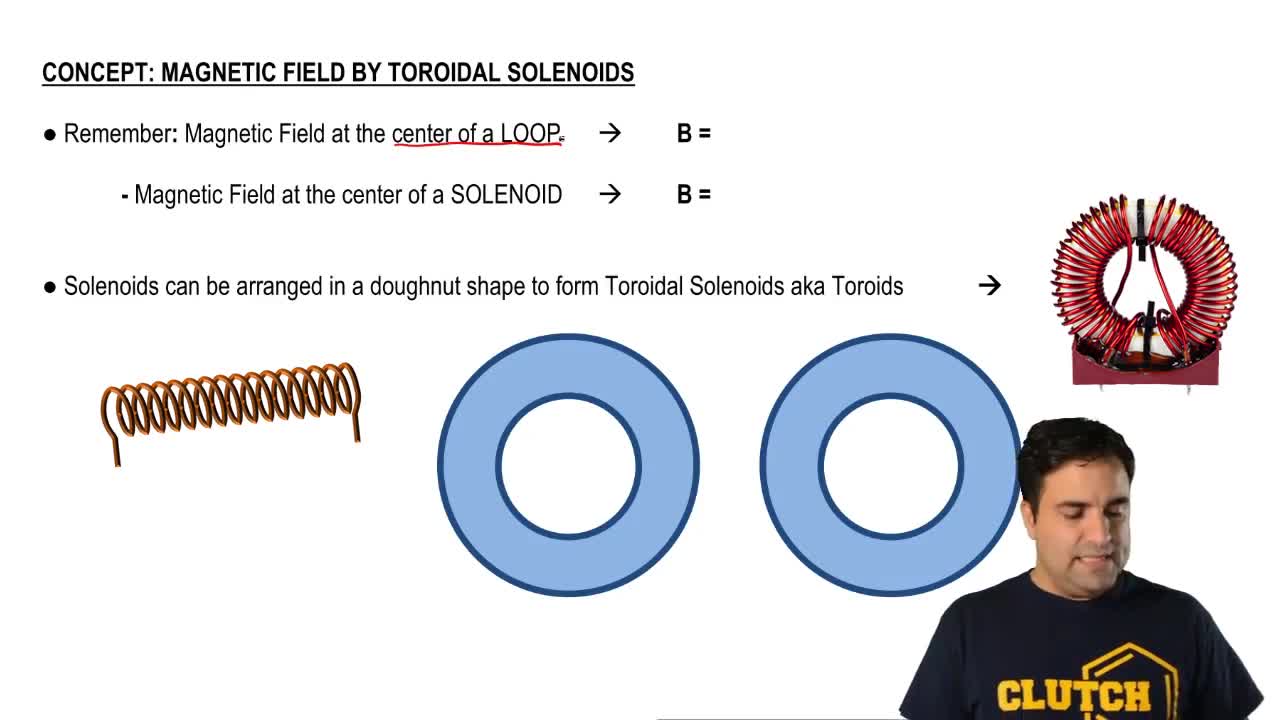
Toroidal Solenoids aka Toroids
Related Practice
Textbook Question

(II) For the toroid of Fig. 30–26, determine the energy density in the magnetic field as a function of r(r₁ < r < r₂) and integrate this over the volume to obtain the total energy stored in the toroid, which carries a current I in each of its N loops.


<IMAGE>

1
views
Textbook Question

(III) Determine the emf induced in the square loop in Fig. 29–52 if the loop stays at rest and the current in the straight wire is given by I(t) = (15.0 A) sin (2200 t) where t is in seconds. The distance a is 12.0 cm, and b is 15.0 cm.

2
views
Textbook Question

(III) A toroid has a rectangular cross section as shown in Fig. 30–26. Show that the self-inductance is


L=μ0N2h2πlnr2r1L = \(\frac{\mu_0 N^2 h}{2\pi}\) \(\ln\) \(\frac{r_2}{r_1}\)


where N is the total number of turns and r₁, r₂ and h are the dimensions shown in Fig. 30–26. [Hint: Use Ampère’s law to get B as a function of r inside the toroid, and integrate.]


2
views
Textbook Question

A coil has 3.25-Ω resistance and 440-mH inductance. If the current is 3.00 A and is increasing at a rate of 3.15 A/s, what is the potential difference across the coil at this moment?

1
views
Textbook Question

What is the energy density at the center of a circular loop of wire carrying a 19.0-A current if the radius of the loop is 28.0 cm?

1
views
Textbook Question

(II) Part of a single rectangular loop of wire with dimensions shown in Fig. 29–49 is situated inside a region of uniform magnetic field of 0.650 T. The total resistance of the loop is 0.250 Ω. Calculate the force required to pull the loop from the field (to the right) at a constant velocity of 3.40 m/s. Neglect gravity.

2
views