
Ch. 30 - Inductance, Electromagnetic Oscillations, and AC Circuits
Giancoli Douglas - Physics for Scientists and Engineers 5th edition
Giancoli Douglas5th editionPhysics for Scientists and EngineersISBN: 9780137488179Not the one you use?Change textbook
Chapter 29, Problem 18

(II) For the toroid of Fig. 30–26, determine the energy density in the magnetic field as a function of r(r₁ < r < r₂) and integrate this over the volume to obtain the total energy stored in the toroid, which carries a current I in each of its N loops.


<IMAGE>

Verified step by step guidance
1
Step 1: Recall the formula for the magnetic field inside a toroid. The magnetic field inside a toroid is given by: B = μ₀NI12πr, where μ₀ is the permeability of free space, N is the number of turns, I is the current, and r is the radial distance from the center of the toroid.
Step 2: Write the expression for the energy density of the magnetic field. The energy density u in a magnetic field is given by: u = 12B21μ₀. Substitute the expression for B from Step 1 into this formula.
Step 3: Express the volume element for the toroid. The toroid can be approximated as a cylindrical shell with a small thickness. The volume element is given by: dV = 2πrLdr, where L is the height of the toroid, r is the radial distance, and dr is the thickness of the shell.
Step 4: Integrate the energy density over the volume of the toroid. The total energy stored in the toroid is given by: U = ∫r₁r₂udV. Substitute the expressions for u and dV into this integral.
Step 5: Simplify the integral and solve. Combine all constants and terms, and integrate with respect to r from r₁ to r₂. This will yield the total energy stored in the toroid.

Verified video answer for a similar problem:

This video solution was recommended by our tutors as helpful for the problem above.
Video duration:
8m
Was this helpful?

Key Concepts

Here are the essential concepts you must grasp in order to answer the question correctly.

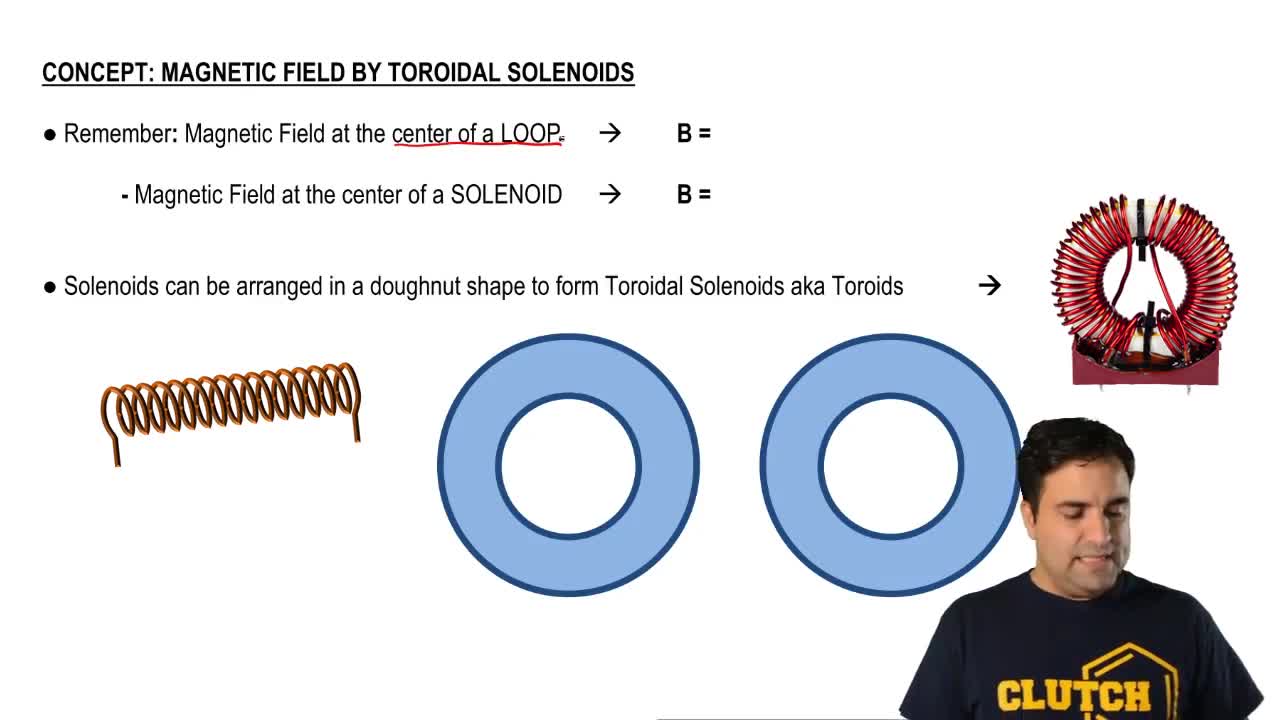
Magnetic Field in a Toroid

A toroid is a doughnut-shaped coil of wire that generates a magnetic field when an electric current flows through it. The magnetic field inside a toroid is uniform and can be expressed as B = (μ₀NI)/(2πr), where μ₀ is the permeability of free space, N is the number of turns, I is the current, and r is the radial distance from the center of the toroid. Understanding this relationship is crucial for calculating the energy density.
Recommended video:
Guided course
11:47
Toroidal Solenoids aka Toroids

Energy Density in a Magnetic Field

The energy density (u) in a magnetic field is given by the formula u = B²/(2μ₀). This equation indicates how much energy is stored per unit volume in the magnetic field. To find the total energy stored in the toroid, one must integrate this energy density over the volume of the toroid, taking into account the varying magnetic field strength as a function of the radial distance r.
Recommended video:
Guided course
05:30
Magnetic Fields and Magnetic Dipoles

Volume Integration

Volume integration is a mathematical process used to calculate the total quantity (such as energy) distributed over a three-dimensional space. In the context of the toroid, this involves integrating the energy density function over the volume defined by the inner radius r₁ and outer radius r₂. This step is essential for determining the total energy stored in the magnetic field of the toroid.
Recommended video:
Guided course
11:43
Finding Moment Of Inertia By Integrating
Related Practice
Textbook Question

(III) Determine the emf induced in the square loop in Fig. 29–52 if the loop stays at rest and the current in the straight wire is given by I(t) = (15.0 A) sin (2200 t) where t is in seconds. The distance a is 12.0 cm, and b is 15.0 cm.

2
views
Textbook Question

(III) A toroid has a rectangular cross section as shown in Fig. 30–26. Show that the self-inductance is


L=μ0N2h2πlnr2r1L = \(\frac{\mu_0 N^2 h}{2\pi}\) \(\ln\) \(\frac{r_2}{r_1}\)


where N is the total number of turns and r₁, r₂ and h are the dimensions shown in Fig. 30–26. [Hint: Use Ampère’s law to get B as a function of r inside the toroid, and integrate.]


2
views
Textbook Question

What is the energy density at the center of a circular loop of wire carrying a 19.0-A current if the radius of the loop is 28.0 cm?

1
views
Textbook Question

(II) (a) Determine the energy stored in the inductor L as a function of time for the LR circuit of Fig. 30–6a. (b) After how many time constants does the stored energy reach 99.9% of its maximum value?

2
views
Textbook Question

(II) (a) In Fig. 30–28, assume that the switch has been in position A for sufficient time so that a steady current I₀ = V₀/R flows through the resistor R. At time t = 0, the switch is quickly switched to position B and the current decays through resistor R' (which is much greater than R) according to I=I0et/τI = I_0 e^{-t/\(\tau\)'}I=I0et/τI = I_0 e^{-t/\(\tau\)'}. Show that the maximum emf εmax induced in the inductor during this time period is (R'/R)Vo. (b) If R' = 45R and Vo = 145 V, determine εmax. [When a mechanical switch is opened, a high-resistance air gap is created, which is modeled as R' here. This Problem illustrates why high-voltage sparking can occur if a current-carrying inductor is suddenly cut off from its power source. The very high voltage can produce an electric field great enough to ionize atoms of air, which emit light when electrons recombine with the ions.]

1
views
Textbook Question

The magnetic field inside an air-filled solenoid 38.0 cm long and 2.10 cm in diameter is 0.720 T. Approximately how much energy is stored in this field?

1
views