
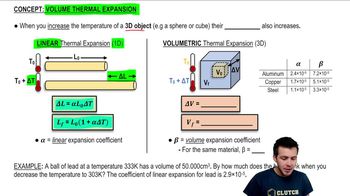
A brass lid screws tightly onto a glass jar at 15°C. To help open the jar, it can be placed into a bath of hot water. After this treatment, the temperatures of the lid and the jar are both 55°C. The inside diameter of the lid is 7.0 cm. Find the size of the gap (difference in radius) that develops by this procedure.
Giancoli Douglas 5th edition
Ch. 17 - Temperature, Thermal Expansion, and the Ideal Gas Law
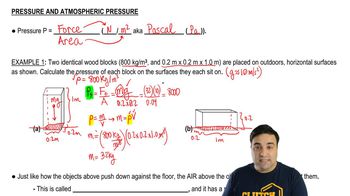
Problem 80From the known value of atmospheric pressure at the surface of the Earth, estimate the total number of air molecules in the Earth’s atmosphere.
Verified step by step guidance
Verified video answer for a similar problem:
Key Concepts
Atmospheric Pressure
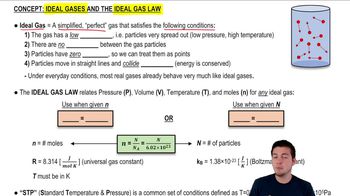
Ideal Gas Law
Molar Volume
Assume that in an alternate universe, the laws of physics are very different from ours and that “ideal” gases behave as follows: At constant pressure, the volume varies directly with the 2/3 power of the temperature.
Assume that in an alternate universe, the laws of physics are very different from ours and that “ideal” gases behave as follows: At 273.15 K and 1.00 atm pressure, 1.00 mole of an ideal gas is found to occupy 22.4 L. Obtain the form of the ideal gas law in this alternate universe, including the value of the gas constant R.
A helium balloon has volume V₀ and temperature T₀ at sea level where the pressure is P₀ and the air density is ρ₀. The balloon is allowed to float up in the air to altitude y where the temperature is T₁. Show that the buoyant force does not depend on altitude y. Assume that the skin of the balloon maintains the helium pressure at a constant factor of 1.05 times greater than the outside pressure. [Hint: Assume that the pressure change with altitude is P = P₀ e⁻ᶜʸ , Eq. 13–6c in Chapter 13.]
Assume that in an alternate universe, the laws of physics are very different from ours and that “ideal” gases behave as follows: At constant temperature, pressure is inversely proportional to the square of the volume.
A copper wire sags 54.0 cm between two utility poles 30.0 m apart when the temperature is -15° C. Estimate the amount of sag when the temperature is + 35° C. [Hint: An estimate can be made by assuming the shape of the wire is approximately an arc of a circle; hard equations can sometimes be solved by guessing values.]